![If any man serve me, let him follow me [John 12:26]](https://onevisit.org/wp-content/uploads/2025/04/cropped-onevisit_final.jpg)
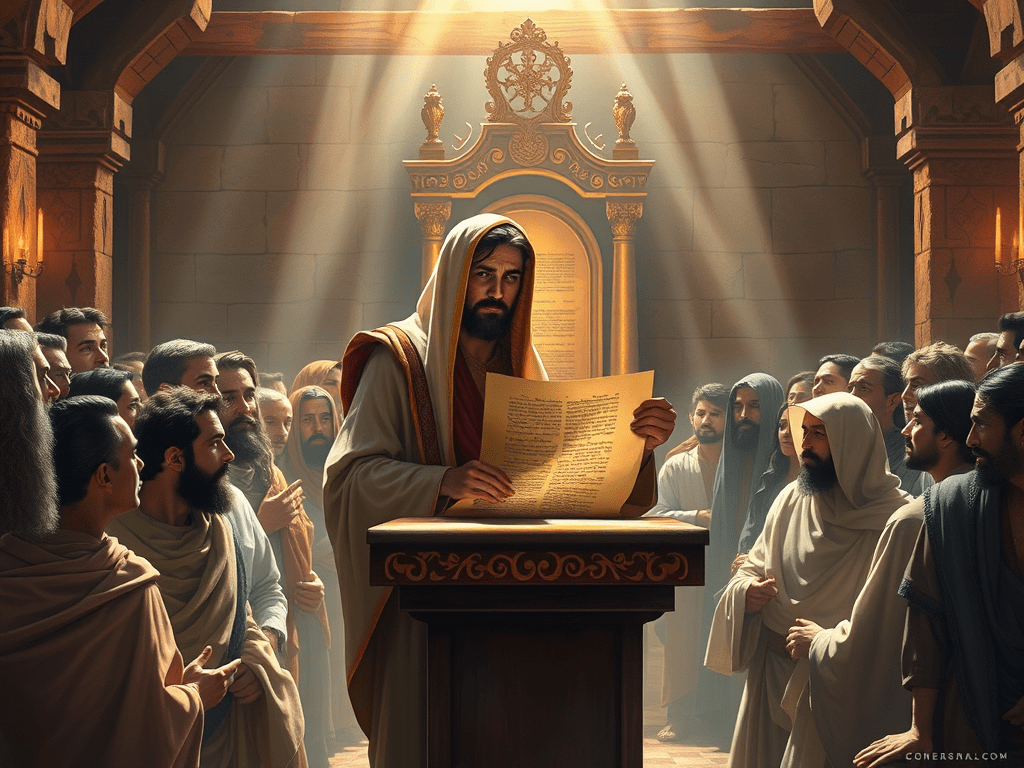
In the first century, Jewish society preserved the Torah through two major traditions — written and oral. The written Torah was maintained in scrolls, carefully copied by scribes to ensure accuracy. The oral tradition involved families memorizing assigned portions, passing them down through generations to keep God’s Word alive in their hearts. The Torah consisted of the first five books of Moses—Genesis, Exodus, Leviticus, Numbers, and Deuteronomy—while the Haftarah included readings from the Prophets and Writings. These portions were read weekly in synagogues, ensuring the entire Scripture was recited regularly among the people.
According to John 1:28, after His baptism in Bethabara beyond the Jordan, Yeshua was led by the Spirit into the wilderness, where He fasted and was tempted for forty days. After overcoming temptation, He began His public ministry in Galilee, centering His work around Capernaum (Matthew 4:12–13; Mark 1:14; Luke 4:14). When the time came for His family to participate in the synagogue readings at Nazareth, Yeshua traveled from Capernaum to His hometown. His family had been entrusted with the Haftarah portion from the book of the prophet Isaiah.
During that time, every synagogue had a special seat known as the Seat of Moses—a place reserved for the rabbi or teacher. This seat symbolized authority and divine teaching, as noted in Matthew 23:2. The Jews also believed that the Messiah, often referred to as the “Second Moses,” would one day sit in that seat. When Yeshua stood up to read from Isaiah and then sat down in the Seat of Moses, His actions carried deep symbolic meaning. It was a silent yet powerful declaration that He was the fulfillment of prophecy—the awaited Messiah.
After reading, Yeshua handed the scroll to the minister and began to speak (Luke 4:20–21). In synagogue custom, this was known as the Dvar Torah—a short commentary or interpretation of the passage, similar to a sermon. As He declared, “This day is this scripture fulfilled in your ears,” Yeshua openly identified Himself as the fulfillment of Isaiah’s prophecy. His words implied that the long-awaited redemption had arrived in His person.
However, the people of Nazareth, familiar with Yeshua’s humble upbringing, refused to accept His claim. They could not reconcile the boy they knew as Joseph’s son with the promised Messiah. As Luke 4:21–29 records, their initial amazement turned to fury. They drove Him out of the synagogue and up to the hilltop upon which the city stood, intending to throw Him off. Yet Yeshua passed through their midst unharmed, for His time had not yet come.
This episode reveals profound truths about Yeshua’s mission and the spiritual blindness of His generation. The One who came to fulfill the Torah was rejected in His own hometown. He, the living Word, read the written Word, declared it fulfilled, and yet was cast out by those who had waited centuries for the Messiah. The scene in Nazareth marks the beginning of Yeshua’s revelation to Israel—proclaiming that God’s promises had come to life in Him.
 If any man serve me, let him follow me [John 12:26]