![If any man serve me, let him follow me [John 12:26]](https://onevisit.org/wp-content/uploads/2025/04/cropped-onevisit_final.jpg)
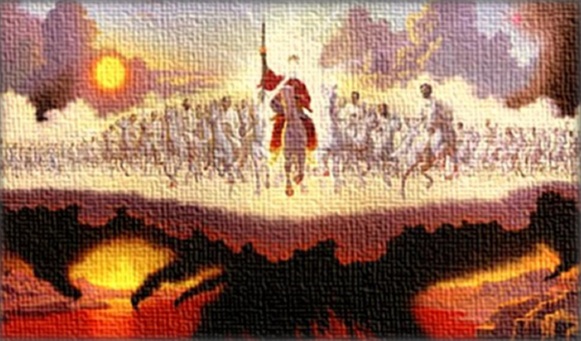
The Next Coming of Yeshua the Messiah is described in Scripture using the Greek term parousia, a word that signifies a person’s presence or arrival. Unlike the term associated with the Rapture—where believers are caught up to meet the Lord—the word parousia consistently refers to Messiah’s physical return to Earth. It appears twenty-four times throughout the New Testament, including key passages in Matthew 24, the epistles to the Corinthians and Thessalonians, the writings of Peter, James, John, and the book of Jude. This consistent usage forms the basis for distinguishing the Rapture from the Next Coming: parousia is reserved for Messiah’s visible, bodily return at the end of the age.
Scripture presents numerous characteristics describing this climactic event. First, the Next Coming follows a clearly defined sequence of prophetic signs, primarily the seven-year Tribulation known as Daniel’s 70th Week. Both Daniel 9:24–27 and Yeshua’s Olivet Discourse (Matthew 24:4–29) outline the events leading to this moment. Unlike the Rapture, the Next Coming is not a resurrection or translation event; instead, it is the moment when Messiah returns to the Earth itself, fulfilling prophecies such as Zechariah 14:4, which states His feet will stand on the Mount of Olives.
At this Coming, Yeshua is accompanied by His already-raptured saints (1 Thessalonians 3:13; Jude 14). The saints descend with Him, and no believers are taken back to Heaven at this time. Instead, judgment begins on Earth. The world will visibly witness His return—“every eye will see Him” (Revelation 1:7)—and unbelievers will be taken away in judgment, as described by Yeshua in Matthew 24:37–41. This removal includes rebellious humanity as well as Satan’s agents: the Antichrist and the False Prophet, who are cast into judgment (Revelation 19:20; 20:1–3).
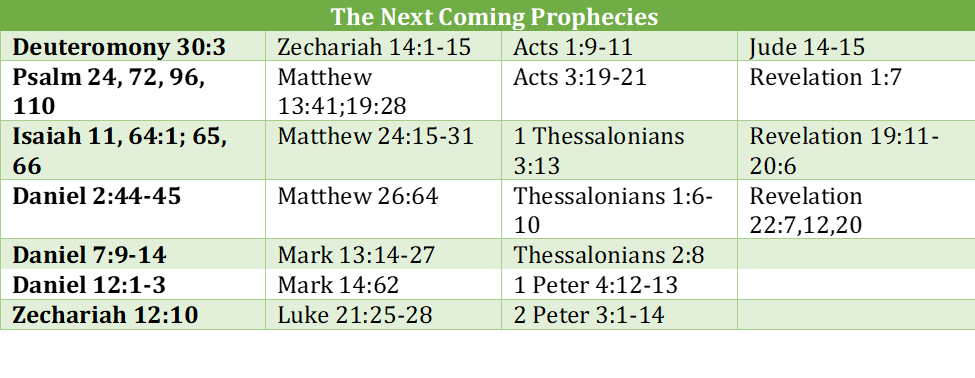
During the Next Coming, the angels will gather the elect of Israel (Matthew 24:31), fulfilling promises of national restoration found throughout the prophets. This event is also deeply rooted in the Old Testament, where numerous passages foretell the Messiah’s return in glory, judgment, and kingdom establishment. These include prophecies in Deuteronomy, the Psalms, Isaiah, Daniel, and Zechariah.
Timing is another important aspect: the Next Coming occurs at the end of the Tribulation—the final day of God’s wrath—and immediately before the inauguration of the Millennial Kingdom. It coincides with the climax of the Battle of Armageddon, after which Messiah will judge the surviving Jews and Gentiles (Matthew 25:31–46). This judgment separates the righteous from the wicked and determines who will enter the Millennial reign.
A broad collection of Scriptures confirms this event, spanning both Testaments. Prophetic books like Daniel, Zechariah, and Isaiah, along with Gospel passages, apostolic letters, and the book of Revelation, collectively paint a cohesive picture of the Messiah’s triumphant return.
In general, those who embrace a literal understanding of Messiah’s first advent—His virgin birth, His death, and His resurrection—also affirm a literal Next Advent. The Next Coming of Yeshua is therefore understood not as symbolic imagery but as a concrete, future event central to God’s redemptive plan.
 If any man serve me, let him follow me [John 12:26]