![If any man serve me, let him follow me [John 12:26]](https://onevisit.org/wp-content/uploads/2025/04/cropped-onevisit_final.jpg)
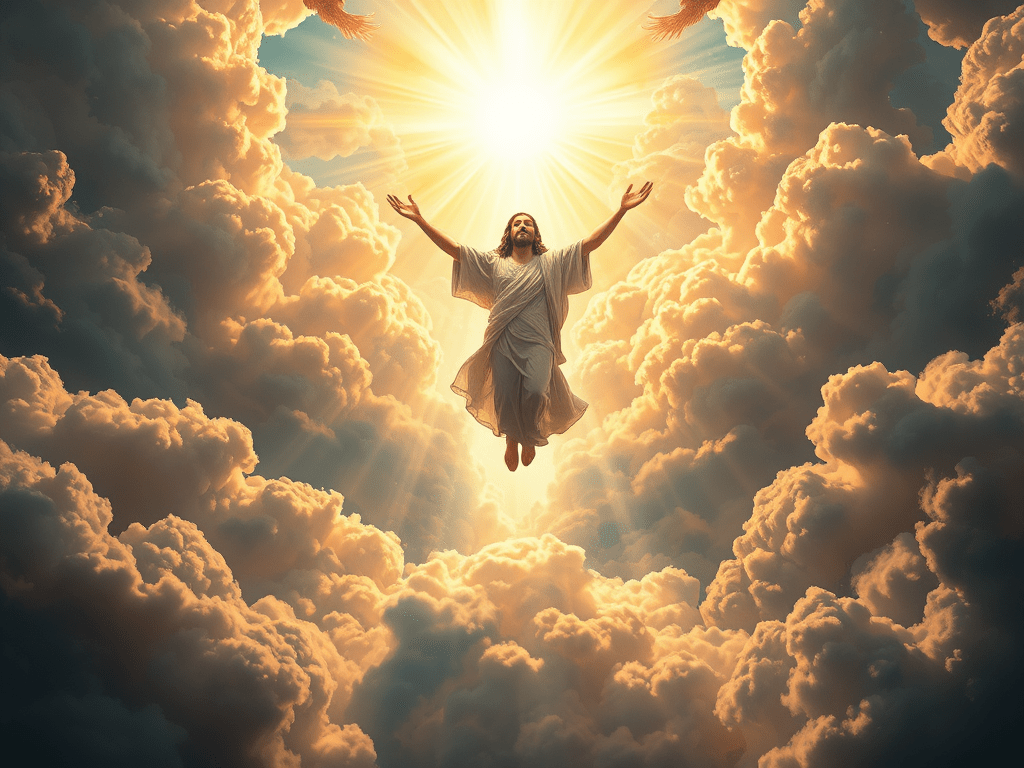
The Ascension of Yeshua the Messiah into heaven carries profound theological meaning, marking both the completion of His earthly mission and the beginning of His exalted heavenly ministry. First, the ascension affirms that Yeshua has returned to the Father who lovingly sent Him into the world at Bethlehem. His time of earthly limitation—living within the boundaries of human flesh and subject to the conditions of mortality—has come to an end. The return to the Father signals a transition from His humble incarnation to the fullness of His divine position in glory.
The ascension also declares the success of Yeshua’s earthly work. Every aspect of the mission entrusted to Him by the Father has been fulfilled. Through His life, death, and resurrection, Yeshua has secured victory over humanity’s greatest enemies: sin, death, and the devil. None of these powers can claim authority over Him or over those who belong to Him. His triumph is complete and final, establishing Him as the conquering Messiah who overcomes all evil.
Contrary to the idea that Yeshua is now restricted to one location in heaven, the ascension actually reveals His universal authority and divine presence. Because He has ascended, He is free from earthly limitations and able to be present wherever He has promised—among His people, in His Church, and through His Spirit. Scripture emphasizes that He now possesses all power in heaven and on earth. As Psalm 115:3 declares, “Our God is in the heavens; He does all that He pleases.” Yeshua’s enthronement makes Him the supreme ruler over all creation.
His ascension also marks the restoration of His heavenly glory. During His earthly life, Yeshua’s divine majesty was veiled, except for the brief revelation at the Transfiguration (Matthew 17:1–9). Returning to heaven means resuming the radiant splendor and honor that belong to Him eternally as the Son of God.
The ascension further symbolizes Yeshua’s exaltation by the Father. As Ephesians 1:20–23 teaches, the Father has raised Him and seated Him at His right hand—the position of ultimate honor and authority. Philippians 2:9 affirms that God has given Him “the name above every name,” ensuring that every knee will bow and every tongue will confess Him as Lord. The ascension thus signifies the Father’s full approval and exaltation of His Son.
Presently, Yeshua reigns from heaven at the right hand of the Father. Scripture portrays Him as the Head of the Church (Colossians 1:18), the giver of spiritual gifts (Ephesians 4:7–8), and the One who fills all things in every way (Ephesians 4:9–10). From this exalted position, He prepares a place for His people (John 14:2) and continues His ministry as the High Priest (Hebrews 4:14–16) and Mediator of the New Covenant (Hebrews 9:15).
Finally, the ascension establishes the pattern for His return. Just as He departed—physically, visibly, and in the clouds—so He will come again to establish His Kingdom (Acts 1:11; Daniel 7:13–14; Matthew 24:30; Revelation 1:7). The ascension therefore not only concludes His earthly ministry but also anticipates His future reign and the fulfillment of God’s redemptive plan.
 If any man serve me, let him follow me [John 12:26]