![If any man serve me, let him follow me [John 12:26]](https://onevisit.org/wp-content/uploads/2025/04/cropped-onevisit_final.jpg)
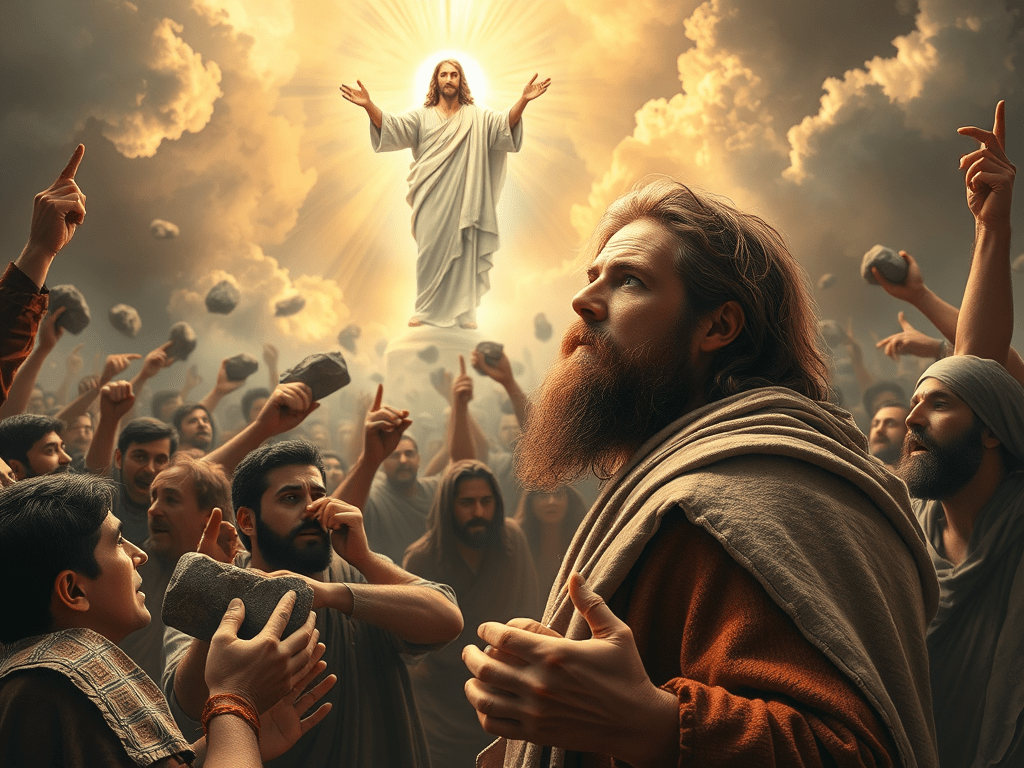
After Yeshua the Messiah ascended into Heaven, the New Testament records several significant appearances that confirmed His continued presence and authority. These post-ascension revelations strengthened the early believers, reassured them of His kingship, and directed the growth of the early Church.
The first recorded appearance after the Ascension occurs in the account of Stephen, the first martyr. As Stephen faced execution, he was granted a vision of “the glory of God” with Yeshua standing at God’s right hand (Acts 7:55). This moment not only affirmed Stephen’s faith but also testified that Yeshua continued to act as the exalted Messiah, actively involved in the lives of His followers.
Another major encounter happened on the road to Damascus, where Saul—later known as Paul—was dramatically confronted by a blinding light and the voice of Yeshua declaring, “I am Yeshua whom you are persecuting” (Acts 9:3–5). This turning point transformed Saul from a persecutor of believers into one of the most influential apostles. Shortly afterward, Yeshua appeared to Ananias in Damascus, instructing him to minister to Saul and baptize him (Acts 9:10–19). This confirmed that Yeshua was guiding not only Paul’s life but also the community that would receive him.
Yeshua continued to direct Paul’s ministry in later years. While Paul was in Corinth—after baptizing Crispus, the synagogue leader—the Lord appeared to him in a night vision, encouraging him to remain there and continue preaching without fear (Acts 18:9). Later, Yeshua appeared to Paul in the Temple at Jerusalem, commanding him to take the message to the Gentiles (Acts 22:17–21). Still another appearance occurred when Paul was under threat in Jerusalem; Yeshua stood beside him and assured him that he would bear witness in Rome as well (Acts 23:11).
The final and most expansive post-ascension appearance is recorded in the Book of Revelation, where Yeshua reveals Himself to John on the island of Patmos. Throughout the visions—especially in chapters 1, 4, 5, 6, 7, 8, 11, 14, 19, and 22—Yeshua appears as the glorified Son of Man, the Lamb, and the victorious King who will return to establish His rule over all creation.
These appearances reinforced the disciples’ conviction that the Messiah who rose from the dead also reigns as the true and sovereign King of the universe. The Ascension was not simply the end of Yeshua’s earthly ministry; it was the moment that launched the disciples into bold witness, knowing that their loyalty was to a living, reigning Messiah—even when such loyalty cost them their lives. Their mission was not a private belief but a response to the undeniable reality they had seen.
Peter embodies this conviction in his sermon at Pentecost. He proclaims the death, resurrection, and ascension of Yeshua as inseparable parts of the gospel (Acts 2:22–36). He concludes by declaring that God has made the crucified Yeshua both “Lord and Messiah,” fulfilling David’s prophetic words about the One who sits at God’s right hand.
Without the ascension, believers would have little purpose beyond personal desires and small, self-made ambitions. But because Yeshua descended as our Savior and ascended as our true King, His followers participate in a Kingdom far greater than themselves—a Kingdom active both in heaven and on earth (Acts 1:9).
 If any man serve me, let him follow me [John 12:26]