![If any man serve me, let him follow me [John 12:26]](https://onevisit.org/wp-content/uploads/2025/04/cropped-onevisit_final.jpg)
As Passover approached, Yeshua traveled south from Galilee—His home region and the center of much of His ministry—toward Jerusalem. Following the common festive routes, He passed through Judea, crossed the Jordan, traveled through Jericho, and finally arrived at Bethphage and Bethany, just outside Jerusalem. Bethany became His base during Passover week, as thousands of pilgrims filled Jerusalem and many stayed in nearby towns. Meanwhile, the political and religious elite waited within Jerusalem—leaders who enjoyed their privileged status under Roman rule and viewed any popular messianic figure as a threat.
Six days before Passover, Yeshua reached Bethany, the town of Lazarus, whom He had raised from the dead. The miracle had stirred immense public interest, and many came both to see Yeshua and Lazarus. During this time He also healed Bartimaeus, the blind beggar. Excitement and messianic expectations grew rapidly among the crowds gathering for Passover.
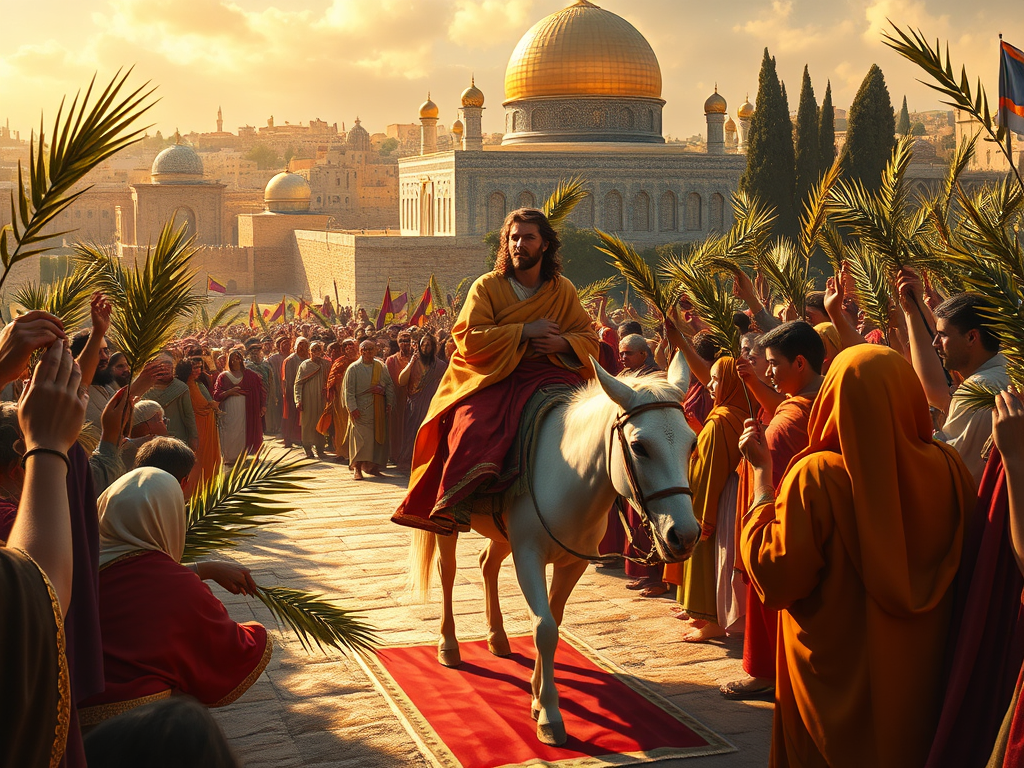
The next day, hearing that Yeshua was coming into Jerusalem, a great crowd prepared to welcome Him. As recorded in all four Gospels, He sent two disciples to bring a donkey and its colt. His entrance into the city fulfilled the prophecy of Zechariah: the King coming meekly, riding on a donkey. The people responded with symbols of national hope—laying cloaks on the road, waving palm branches, and shouting the messianic cry from Psalm 118: “Hosanna to the Son of David! Blessed is he who comes in the name of the Lord!” This acclamation recognized Yeshua as the hoped-for Messiah, the heir to David’s throne.
Yet the crowds’ expectations were political rather than spiritual. They longed for a king who would overthrow Roman power and restore Israel’s independence. They overlooked prophecies like Isaiah 53 describing the Messiah as a suffering servant who would bear the sins of the people. Although they shouted “hosanna in the highest,” they did not understand the deeper salvation Yeshua was bringing—freedom not from Rome but from sin and death.
Upon entering Jerusalem, Yeshua did not march to the Antonia Fortress to confront the Romans. Instead, He went directly to the Temple courts, where corruption flourished among the money changers and merchants. By overturning their tables and driving them out, He directly challenged the Temple leadership and exposed the spiritual decay at the heart of Israel’s religious system. That night He returned to Bethany.
The next morning Yeshua cursed the fig tree—a symbolic act representing Israel’s spiritual barrenness. He then engaged the chief priests, scribes, and Pharisees through parables and debates, further heightening their hostility. They feared arresting Yeshua publicly because of His popularity with the crowds, who filled the Temple area during the day. Their strategy became clear: seize Him secretly and away from His supporters.
During these days Yeshua continued teaching on the end times, judgment, and the Kingdom of God. Meanwhile, the leaders plotted His death. They sought a way to capture Him quietly, and Judas provided the opportunity. At night, in the Garden of Gethsemane—outside the crowds’ reach—Yeshua was arrested. He was taken first before the Sanhedrin in an illegal nighttime trial. The council had only one goal: condemn Him.
At daybreak, Yeshua was brought to Pilate, the Roman governor. The crowd gathered there was not the same multitude that had welcomed Him as Messiah. This group consisted largely of the priests, pharisees, elders, and those under their influence—people who wanted Him executed. Most pilgrims and supporters would still have been in their lodgings or were entering the city through different gates, unaware of what was unfolding.
In the narrow courtyard outside Herod’s palace, the leaders stirred the assembled crowd to shout, “Crucify Him!” Pilate, pressured by political considerations and the risk of unrest, handed Yeshua over to be crucified, though he found no guilt in Him. By 9 a.m., Yeshua was nailed to the cross at Calvary, fulfilling the prophetic pattern of the Passover lamb sacrificed in the morning and evening. By 3 p.m., as the shofar sounded from the Temple announcing the sacrifice of the lamb for the nation, Yeshua declared, “It is finished,” and gave up His spirit.
At His death, the veil of the Temple was torn in two from top to bottom. This divine act signified that through Yeshua’s sacrifice, the way into God’s presence was now open for all. The earth shook, rocks split, and many realized something extraordinary had occurred. Meanwhile, most of those who had hailed Him as king only days earlier discovered the crucifixion later, many encountering Him on the road or after the event.
The two seemingly contradictory crowds—one shouting “Hosanna” and the other “Crucify Him”—were not the same. The second crowd was strategically assembled by the leaders at a time and place designed to exclude Yeshua’s supporters. Thus, the triumphal entry and the crucifixion reveal the contrast between human expectation and God’s redemptive plan. Yeshua did not come to overthrow Rome but to establish the eternal Kingdom through His death and resurrection, fulfilling Scripture and accomplishing salvation for all humanity.
 If any man serve me, let him follow me [John 12:26]