![If any man serve me, let him follow me [John 12:26]](https://onevisit.org/wp-content/uploads/2025/04/cropped-onevisit_final.jpg)
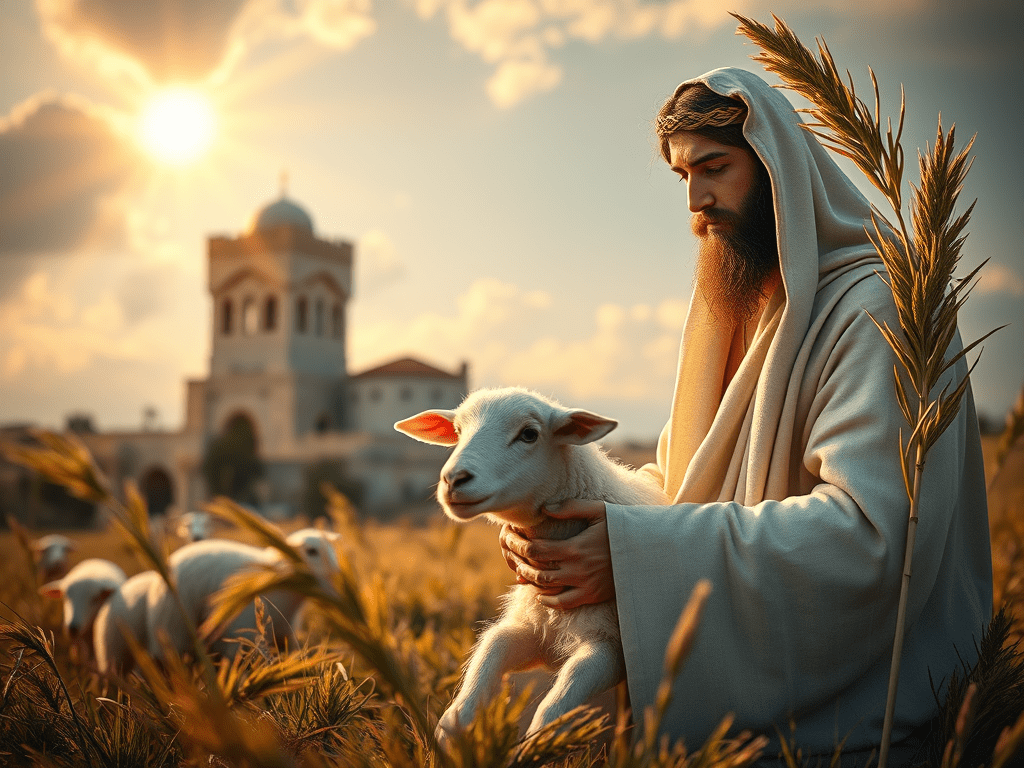
The theme of Yeshua as the perfect and faultless Lamb of God is deeply rooted in the Old Testament sacrificial system, which God instituted to reveal both the seriousness of sin and the necessity of a substitutionary sacrifice. Daily offerings, sin offerings, and festival sacrifices (Exodus 29; Leviticus 4; 23) all served as prophetic shadows pointing toward a final and complete atonement. The prophets Jeremiah and Isaiah foretold a suffering Servant who would be led like a lamb to the slaughter and whose sacrifice would redeem Israel (Jeremiah 11:19; Isaiah 53:7,10). Thus, when John the Baptist – a Levitical priest – publicly declared Yeshua as “the Lamb of God who takes away the sin of the world” (John 1:29,36), his Jewish audience instantly understood the sacrificial imagery and priestly significance of that announcement.
Yeshua’s identity as God’s sacrificial Lamb is reinforced by His birthplace. He was born in Bethlehem Ephrathah, the very region where priests raised lambs specifically for Temple sacrifice. According to early Jewish tradition, many of these lambs were born and inspected at Migdal Eder, a shepherds’ tower referenced in Micah 4:8. Thus, the Lamb of God was born in the same place where sacrificial lambs were raised and inspected for perfection, fulfilling prophecy with divine precision.
The Passover rituals offer an even clearer picture. Each year, the High Priest traveled to Bethlehem to select a spotless firstborn lamb. On the 10th of Nisan, he carried this lamb through the Eastern (Shushan) Gate into Jerusalem while people waved palm branches and shouted praises. Four days of public inspection followed, ensuring the lamb was without defect before its sacrifice on Passover. Precisely parallel to this, Yeshua entered Jerusalem on a donkey through the Eastern Gate on the 10th of Nisan, fulfilling Zechariah 9:9. The crowds greeted Him with palm branches because they had heard about the resurrection of Lazarus—a Messianic sign. Over the next four days, Yeshua was publicly examined by priests, Pharisees, Sadducees, Herod, and Pilate himself. After thorough scrutiny, Pilate declared, “I find no fault in this man,” confirming Yeshua as perfectly sinless and therefore fit to be the Passover Lamb.
The timing of Yeshua’s crucifixion also aligns exactly with Temple rituals. The lambs for Passover were sacrificed at 3 p.m., following the morning offering at 9 a.m. Yeshua was nailed to the cross at 9 a.m., and at 3 p.m.—the exact moment the national Passover lamb was slain—He surrendered His spirit and cried, “It is finished.” As the shofar sounded from the Temple, signaling the completion of the sacrifice, Yeshua, the true Passover Lamb, brought God’s eternal plan to fulfillment. Darkness covered the land from noon to three, God tore the Temple veil from top to bottom, and the earth quaked—signs that the perfect sacrifice had been offered and that access to God was now open to all.
Just as none of the Passover lamb’s bones were to be broken, none of Yeshua’s bones were broken, fulfilling Exodus 12 completely and perfectly. His sacrifice was faultless—physically spotless and spiritually sinless.
The Day of Atonement (Yom Kippur) foreshadowed another dimension of Yeshua’s work. Two goats were presented: one sacrificed “for the Lord” and one sent away into the wilderness “for Azazel,” symbolically carrying away Israel’s sins. Ancient writings record that a scarlet wool tied to the scapegoat’s horns would turn white, signifying forgiveness (cf. Isaiah 1:18). Mysteriously, Jewish sources say the wool stopped turning white after Yeshua’s death and resurrection—a sign that the old system had ended. Hebrews 10 explains why: animal sacrifices only covered sin temporarily, but Yeshua’s sacrifice removes sin permanently. As God’s true Passover and Atonement Lamb, He died once for all, providing eternal redemption.
Thus, every detail of the Old Testament sacrificial system—its rituals, timing, priesthood, animals, locations, inspections, and symbols—finds its complete fulfillment in Yeshua the Messiah. From His birth in Bethlehem’s priestly fields to His triumphal entry, from His sinless life to His precisely-timed death, from the tearing of the veil to the end of the scapegoat sign, Yeshua perfectly embodies God’s final and faultless Lamb. Through His blood, humanity receives forgiveness; through His sacrifice, access to God is restored; and through His resurrection, eternal life is secured. He is the Lamb slain from the foundation of the world—the one true atonement God prepared for the salvation of all people.
 If any man serve me, let him follow me [John 12:26]