![If any man serve me, let him follow me [John 12:26]](https://onevisit.org/wp-content/uploads/2025/04/cropped-onevisit_final.jpg)
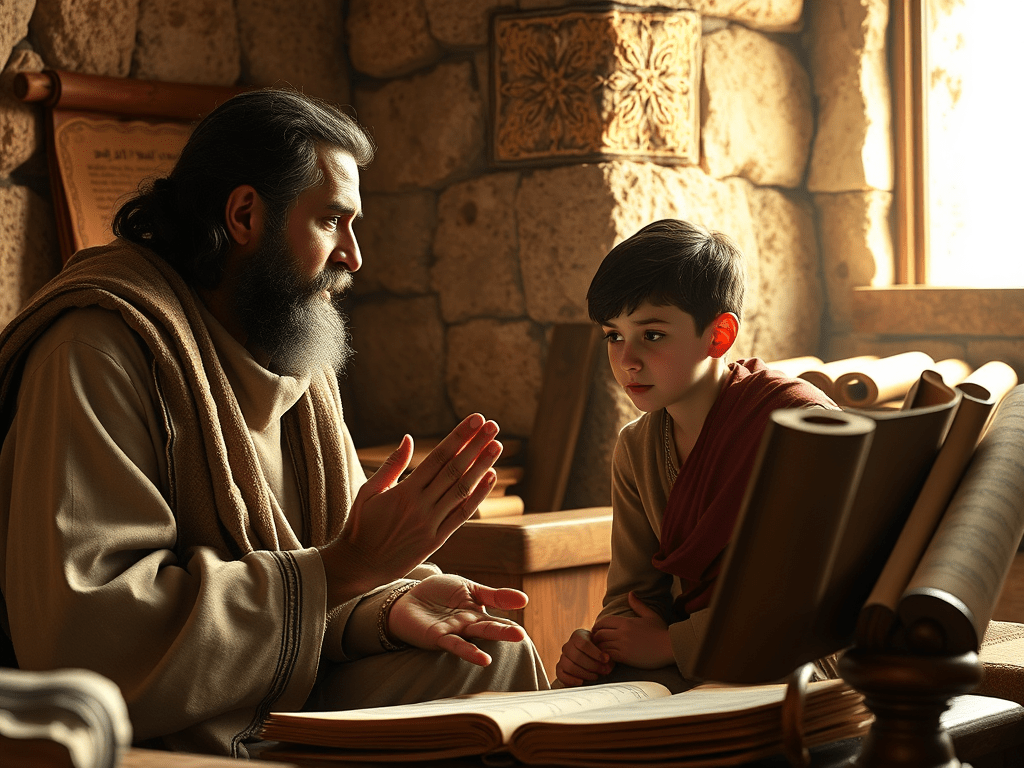
In ancient Israel, education centered on knowing and obeying God’s Law—the Torah, which comprised the first five books of the Bible: Genesis, Exodus, Leviticus, Numbers, and Deuteronomy. The goal of education was not only intellectual understanding but moral and spiritual formation, teaching children to live in covenant relationship with God. Practical instruction was also essential—boys learned trades such as carpentry or farming, while girls were taught domestic skills, including household management, dietary laws, and preparation for marriage.
The home was the foundation of all learning. Parents were considered the child’s primary teachers, responsible for passing down the faith and God’s commandments. Scripture reinforced this duty: Genesis 18:19 commended Abraham for training his household in righteousness, and Proverbs 22:6 instructed parents to guide their children in God’s ways. Deuteronomy 6:7 emphasized that teaching about God should be continuous and woven into daily life—during meals, walks, rest, and work—so that the knowledge of God became inseparable from ordinary experience. Instruction took place through storytelling, imitation, and participation in religious observances like the Sabbath and Passover, helping children to understand their faith in practical ways.
Fathers, especially, were tasked with teaching the Torah by word and example. They modeled devotion through visible acts of faith, such as wearing phylacteries while reciting Deuteronomy 6:5, “Love the Lord your God with all your heart, soul, and might.”
During the New Testament era, the synagogue became the chief center of education. Likely originating during the Babylonian exile, when the Jews were cut off from Temple worship, the synagogue evolved into a place for prayer, Scripture reading, and learning. By the time of Yeshua, nearly every Jewish community had an attached school for children. The synagogue attendant usually served as the teacher, sometimes aided by an assistant. Boys began their formal education around ages five to seven in the Beth Sefer (“House of the Book”), where they studied Scripture half-days for several years. Lessons focused on reading, writing, memorization, and arithmetic, but their ultimate purpose remained spiritual—instilling reverence for God’s Word.
Outside of school, boys apprenticed in trades, continuing practical learning under their fathers. Those seeking higher education could study under renowned scholars, as Saul of Tarsus later did under Gamaliel (Acts 22:3).
In Galilee, mothers guided children’s moral and emotional development until age five, after which fathers assumed responsibility for their sons’ religious and intellectual instruction. According to The Urantia Book, before formal schooling, Yeshua already spoke Aramaic, taught by His mother Miryam, and Greek, learned from His father Joseph. Like other boys, He attended the synagogue school in Nazareth, where the Scriptures were the only textbook until age ten. Luke 2:40 records, “The child grew and became strong, filled with wisdom, and the grace of God was upon Him.”
After completing about six years of formal study, a boy was declared a “son of the commandment,” becoming a full member of Israel and attending Passover in Jerusalem (Luke 2:41–42). During one such visit, twelve-year-old Yeshua stayed in the temple, astonishing the teachers with His deep understanding (Luke 2:46–47). His teachers foresaw greatness in Him, urging further study in Jerusalem’s academies. However, Yeshua knew His calling came not from rabbinical tradition but from His Heavenly Father. From His earliest years, His education combined divine wisdom, humility, and obedience—preparing Him for His mission to reveal God’s truth to humanity.
 If any man serve me, let him follow me [John 12:26]