![If any man serve me, let him follow me [John 12:26]](https://onevisit.org/wp-content/uploads/2025/04/cropped-onevisit_final.jpg)
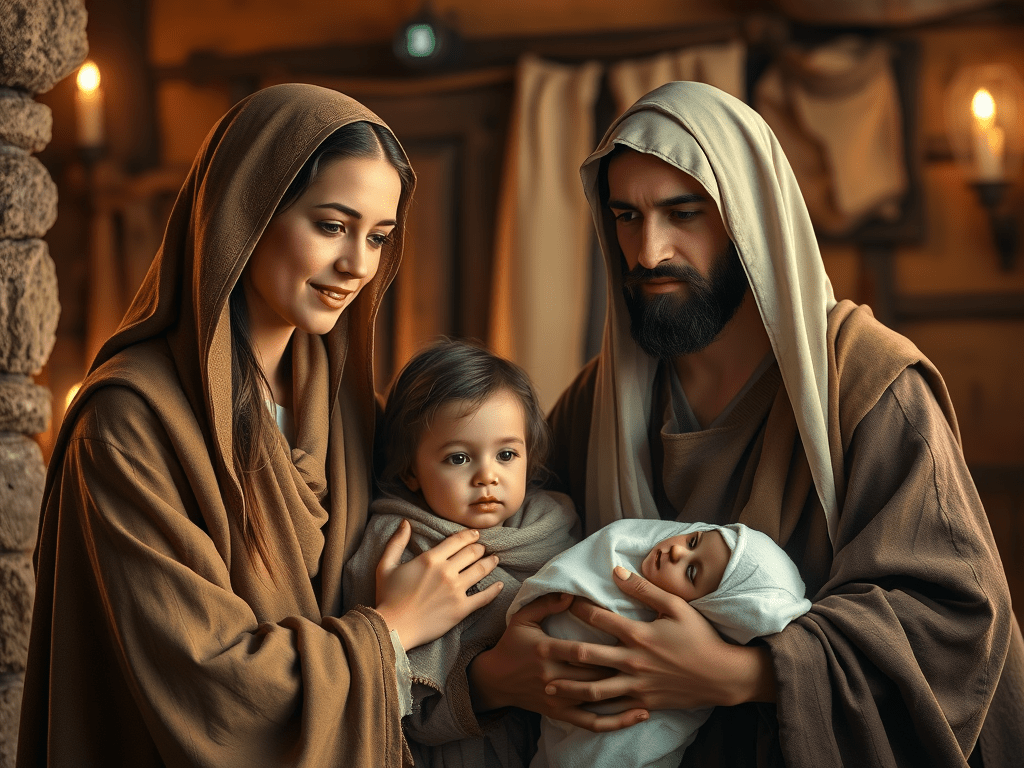
From the biblical account, the clearest indication of Miryam’s (Mary’s) lineage comes from Luke 3:23–38, where Luke records that Joseph, Mary’s husband, was “the son of Heli.” However, Luke does not say that Heli begat Joseph, unlike Matthew 1:16, which states that “Jacob begat Joseph, the husband of Mary.” This distinction suggests that Heli was Mary’s father, making Joseph Heli’s son-in-law rather than his biological son.
The genealogy in Luke, therefore, is generally understood to trace Mary’s ancestry—showing her descent from King David through his son Nathan (Luke 3:31)—while Matthew’s genealogy traces Joseph’s line through Solomon. This interpretation not only reconciles the two accounts but also fulfills God’s promise that the Messiah would come from David’s lineage (Isaiah 9:7; Jeremiah 33:14–15). It also resolves the issue of God’s judgment against Jehoiachin (also called Jeconiah or Coniah), one of Joseph’s ancestors, on whom the Lord declared that none of his descendants would prosper or sit on David’s throne (Jeremiah 22:30). Thus, the Messiah’s legal right to David’s throne came through Joseph, while His bloodline came through Mary.
Mary’s relative Elizabeth, the wife of Zechariah, was from the priestly line of Aaron, of the tribe of Levi (Luke 1:5, 36; Exodus 6:20). Mary, however, was from the tribe of Judah through David (Genesis 35:23; 2 Samuel 7:16). Though related, their tribal heritage was distinct, since tribal descent was traced through the father’s line.
Mary and Joseph were devout followers of God, faithfully observing the feasts and commandments (Luke 2:41–42). Their home was centered on love, obedience, and worship—an environment chosen by God for raising His Son. Economically, they lived humbly. At Yeshua’s dedication, they offered two turtledoves instead of a lamb, the offering prescribed for those who could not afford more (Luke 2:22–24; Leviticus 12:8). Paul later reflected on Yeshua’s humility, noting that though He was rich, He became poor for our sake (Philippians 2:7; 2 Corinthians 8:9).
After Yeshua’s birth, Joseph and Mary had other children. Scripture mentions His brothers—James, Joseph, Judas, and Simon—and unnamed sisters (Matthew 13:55–56; Mark 6:3–4; Acts 1:14; Galatians 1:19). Yeshua grew up in a large family, shouldering great responsibility after Joseph’s death, which occurred when Yeshua was about fourteen or fifteen years old. He became the provider and guardian for His widowed mother and younger siblings, faithfully fulfilling His earthly and heavenly duties.
Despite His divine mission, Yeshua lived a simple life. He owned few possessions and described Himself as having “nowhere to lay His head” (Matthew 8:20). His life exemplified humility, service, and total dependence on His Heavenly Father.
Thus, the biblical record portrays Yeshua’s earthly family as devout, humble, and faithful. Through both Mary’s and Joseph’s lineages, the prophecies of the Messiah’s royal descent were perfectly fulfilled, revealing God’s sovereign plan and the humble circumstances into which the Savior of the world chose to enter.
 If any man serve me, let him follow me [John 12:26]