![If any man serve me, let him follow me [John 12:26]](https://onevisit.org/wp-content/uploads/2025/04/cropped-onevisit_final.jpg)
When Caesar Augustus issued a decree for a census of the entire Roman world—meaning that everyone was to be registered and taxed—each person was required to return to their ancestral home (Luke 2:1–3). Though both Joseph and Miryam (Mary) were descendants of King David, from the tribe of Judah, they did not reside in the region once called Judah. Joseph lived in Nazareth at the time of their betrothal, suggesting that much of his immediate and extended family lived there as well (Luke 2:44; Mark 6:4).
Due to the census, Joseph and Miryam, possibly accompanied by relatives, journeyed to Bethlehem Ephrathah, a small town southwest of Jerusalem. This was their ancestral home and the prophesied birthplace of the Messiah as foretold by the prophet Micah (Micah 5:2; Matthew 2:6; John 7:42). It is unclear how long Joseph’s family had been away from Bethlehem—it may have been generations—and he may not have had close relatives remaining there. Upon arrival, he likely sought lodging among distant kin, but because of the crowded conditions, there was no room for them in the inn (Greek: kataluma, likely a guest room in a private home).
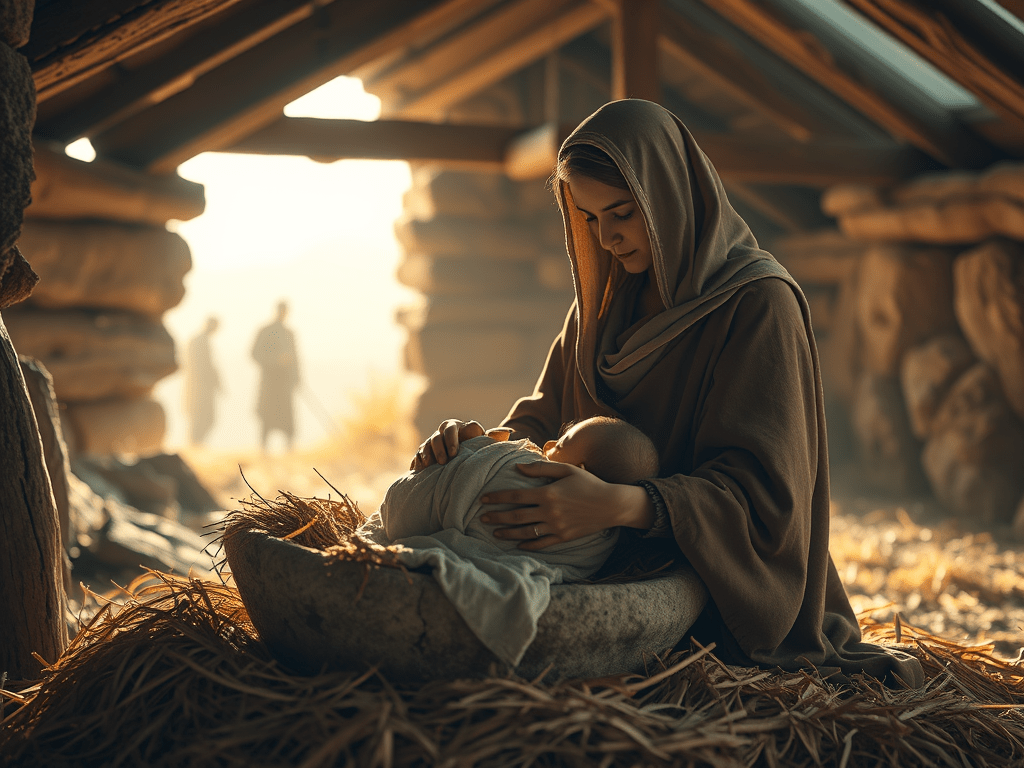
With Bethlehem overcrowded, Joseph and Miryam took refuge in an animal shelter, where a manger—a feeding trough—served as a cradle. Some traditions suggest this may have been in the area of Migdal Eder, the “Tower of the Flock,” where sacrificial lambs were born (Micah 4:8)—a fitting place for the birth of the Lamb of God.
Luke records, “And she brought forth her firstborn Son, and wrapped Him in swaddling cloths, and laid Him in a manger” (Luke 2:7). Contrary to common sayings, Yeshua was not born in a manger but laid in one. These mangers were typically carved from limestone and used as feeding troughs for animals, serving as a humble crib for the newborn Messiah.
Despite the simplicity of His birth, God ensured the safety and provision of the family chosen to raise His Son. Miryam safely delivered Yeshua in Bethlehem, fulfilling prophecy. He would later live a sinless life, die on the cross for humanity’s sins, and rise from the dead in victory.
That night, angels appeared to nearby shepherds, announcing the birth of the Savior (Luke 2:8–20). Unlike earthly kings whose births were celebrated with grandeur, this King was born in humility—welcomed not by royalty, but by a carpenter, his young wife, and humble shepherds keeping watch.
Contrary to popular belief, the wise men (Magi) were not present that night. Scripture indicates their visit occurred months later, when Yeshua was likely between one and two years old, based on King Herod’s calculations (Matthew 2:16).
The humble circumstances of the Messiah’s birth foreshadowed His life and mission—one marked by humility, service, and self-sacrifice. Though born in a lowly setting, He came as the promised King and Savior of the world.
 If any man serve me, let him follow me [John 12:26]