![If any man serve me, let him follow me [John 12:26]](https://onevisit.org/wp-content/uploads/2025/04/cropped-onevisit_final.jpg)

A. Prophecies
Genesis 3:15 reveals the first promise concerning the Messiah, declaring that He will be the seed of the woman: “And I will put enmity between thee and the woman, and between thy seed and her seed; it shall bruise thy head, and thou shalt bruise his heel.”
The Scriptures further affirm that the Messiah will come from the lineage of Abraham. In Genesis 22:17–18, God says, “In blessing I will bless thee, and in multiplying I will multiply thy seed as the stars of the heaven, and as the sand which is upon the seashore; and thy seed shall possess the gate of his enemies. And in thy seed shall all the nations of the earth be blessed; because thou hast obeyed my voice.”
He will also arise from among His own people, Israel. As declared in Deuteronomy 18:18, “I will raise them up a Prophet from among their brethren, like unto thee, and will put My words in His mouth; and He shall speak unto them all that I shall command Him.”
Moreover, the prophet Isaiah foretold that the Messiah would come from the family line of Jesse. Isaiah 11:1 proclaims, “And there shall come forth a rod out of the stem of Jesse, and a Branch shall grow out of his roots.”
The Scriptures go on to specify that He will be a descendant of King David. Jeremiah 23:5–6 declares, “Behold, the days come, saith the LORD, that I will raise unto David a righteous Branch, and a King shall reign and prosper, and shall execute judgment and justice in the earth. In His days Judah shall be saved, and Israel shall dwell safely: and this is His name whereby He shall be called, THE LORD OUR RIGHTEOUSNESS.”
This promise is reaffirmed in Jeremiah 33:14–15, where the Lord says, “Behold, the days come, saith the LORD, that I will perform that good thing which I have promised unto the house of Israel and to the house of Judah. In those days, and at that time, will I cause the Branch of righteousness to grow up unto David; and He shall execute judgment and righteousness in the land.”
B. Fulfilment of Prophecies in Yeshua of Nazareth
Summary Genealogy of Yeshua (Jesus) – Side-by-Side Comparison of Matthew 1:1–16 and Luke 3:23–38.
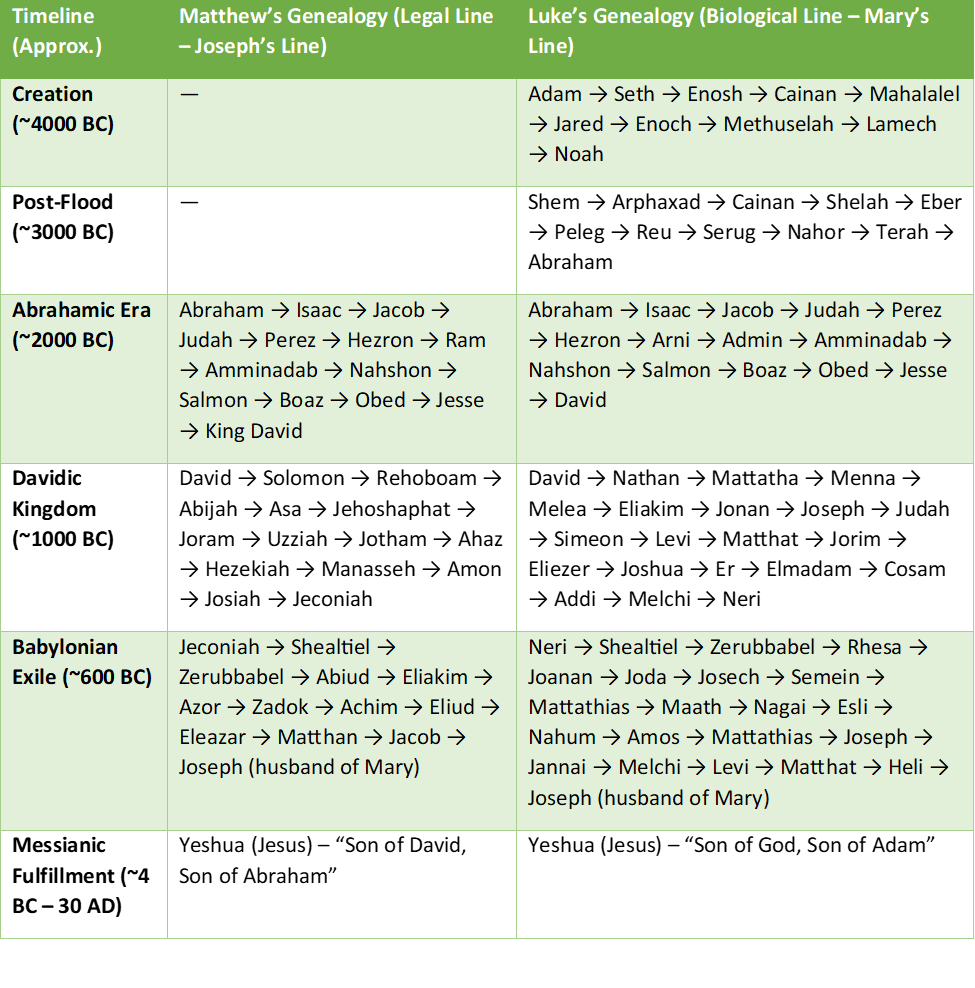
1. Direction of the Genealogy
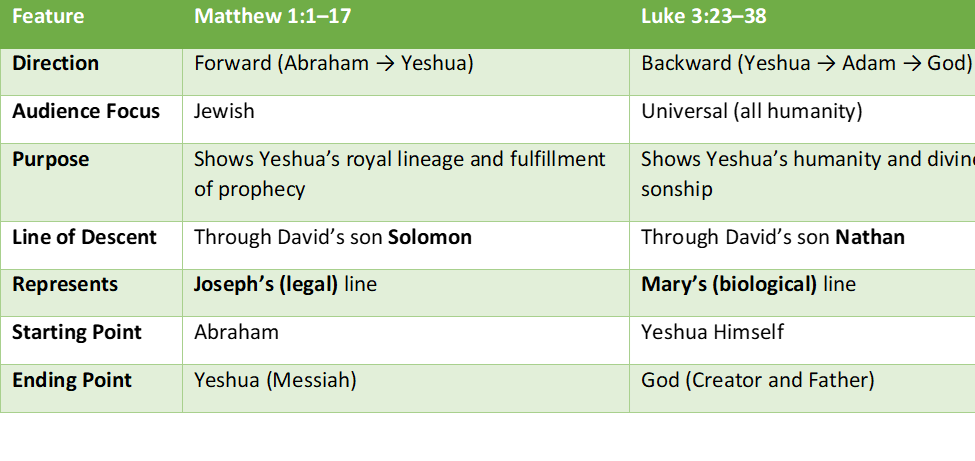
- Matthew’s genealogy moves forward — from Abraham → David → Yeshua, highlighting covenant promises and kingship.
- Luke’s genealogy moves backward — from Yeshua → Adam → God, emphasizing universal salvation and Yeshua’s divine-human identity.
Luke begins with Yeshua’s earthly ministry (around age 30) and traces His lineage back to Adam, showing that He is the Savior for all humanity, not just Israel.
2. Yeshua as “the Son of Adam, the Son of God”
Luke ends the genealogy with:
“…which was the son of Adam, which was the son of God.” (Luke 3:38)
This underlines two vital truths:
- Yeshua is fully human — descended from Adam.
- Yeshua is divine — the eternal Son of God (Luke 1:35).
Through the first Adam came sin and death; through Yeshua, the “last Adam” (1 Corinthians 15:45), comes righteousness and life.
3. The Line through Nathan (Mary’s Line)
Luke traces the line through Nathan, son of David (v. 31), whereas Matthew follows Solomon.
This distinction shows:
- Matthew records the royal/legal line through Solomon → Joseph.
- Luke records the biological/blood line through Nathan → Mary.
Thus, Yeshua is:
- Legally heir to David’s throne through Joseph.
- Biologically a descendant of David through Mary.
4. The Role of Heli
Luke 3:23 says:
“…being (as was supposed) the son of Joseph, which was the son of Heli.”
In Jewish custom, a son-in-law could be listed as a son when a father had no male heirs.
Therefore, Heli is widely understood to be Mary’s father, making Joseph the son (by marriage) of Heli.
This aligns with ancient traditions (e.g., early Christian historian Eusebius, citing Africanus) that Luke gives Mary’s genealogy.
5. Universal Scope of Salvation
By tracing Yeshua’s lineage to Adam, Luke highlights that Yeshua came not just for the Jews, but for all humanity — every nation, tribe, and tongue.
This theme echoes throughout Luke’s Gospel and Acts, where the message of salvation expands to the Gentiles (Acts 10:34–43).
6. Theological Meaning
Luke’s genealogy reveals:
- God’s faithfulness through generations — preserving the Messianic line despite human failures.
- Yeshua’s perfect humanity and divinity — bridging heaven and earth.
- The universality of redemption — from Adam to all mankind.
Through this genealogy, we see that Yeshua is both the fulfillment of prophecy and the hope of all creation — the true “Son of God” who restores what was lost through the first Adam.
Comparison Summary: Matthew vs. Luke
“Which was the son of Enos, which was the son of Seth, which was the son of Adam, which was the son of God.”
— Luke 3:38 (KJV)
This verse completes the sacred lineage, affirming that Yeshua is the divine Son who redeems all sons of Adam — the bridge between God and mankind.
 If any man serve me, let him follow me [John 12:26]