![If any man serve me, let him follow me [John 12:26]](https://onevisit.org/wp-content/uploads/2025/04/cropped-onevisit_final.jpg)
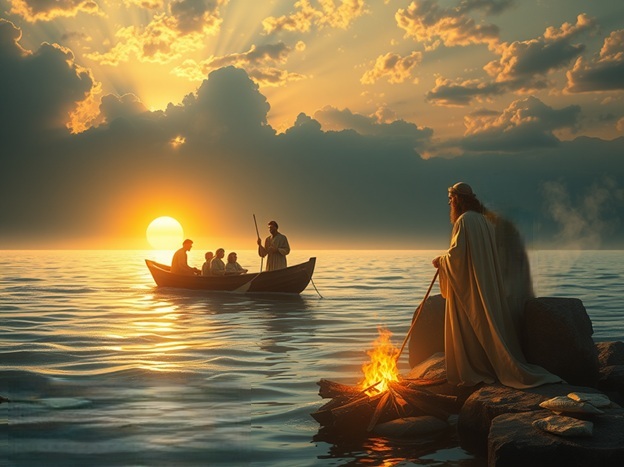
The setting of John 21:1–14 takes place after Yeshua’s resurrection. He had already appeared multiple times to His disciples and others in and around Jerusalem. These appearances confirmed His physical resurrection and brought peace and reassurance to His followers, who had been fearful and scattered after His crucifixion.
After these events, the disciples returned to Galilee, as Yeshua had instructed them (Matthew 28:7,10). This region held deep significance — it was the place where Yeshua first called many of His disciples and performed several miracles, including the miraculous catch of fish at the beginning of His ministry (Luke 5:1–11). Now, following His resurrection, Yeshua would meet them again by the same sea to renew their calling and confirm His continued presence with them.
The group gathered at the Sea of Tiberias included Simon Peter, Thomas (the Twin), Nathanael, James and John (the sons of Zebedee), and two other unnamed disciples (John 21:2). Peter, perhaps restless or uncertain about what to do next, said, “I am going fishing.” The others joined him — a return to their old trade, suggesting confusion or a desire for normalcy after the recent extraordinary events.
The disciples fished all night but caught nothing (John 21:3) — a reminder of their earlier encounter with Yeshua years before, when a similar failure preceded a miraculous catch. At dawn, a man stood on the shore, though they did not recognize Him. He called out, “Children, have you any fish?” They answered, “No.” He then instructed them, “Cast the net on the right side of the boat, and you will find some.”
When they obeyed, they caught so many fish that they could not haul the net in. At that moment, John realized who the man was and said to Peter, “It is the Lord!” (John 21:7). Impulsive and passionate as ever, Peter immediately jumped into the water and swam to shore, leaving the others to bring the boat and the net full of fish.
When they reached land, they found a charcoal fire prepared, with fish and bread laid upon it — a sign of Yeshua’s care and provision. He invited them to bring some of their catch, which numbered 153 large fish — a symbolic total emphasizing abundance and completeness. Despite the quantity, “the net was not broken,” showing divine preservation and unity.
Yeshua then said, “Come and have breakfast.” He took the bread and fish and gave it to them, recalling His earlier miracles of feeding the multitudes and the Last Supper. Through this intimate meal, Yeshua reaffirmed His fellowship and love for His disciples.
This encounter by the Sea of Galilee was more than a miraculous provision — it was a spiritual restoration and recommissioning. Yeshua’s presence turned their fruitless labor into abundance, reminding them that apart from Him, they could do nothing (John 15:5). The unbroken net symbolized the future unity of the Church, and the miraculous catch prefigured their mission to become “fishers of men.”
Yeshua’s meal of bread and fish reinforced the truth of His bodily resurrection — He was not a spirit but alive, tangible, and sustaining. His quiet preparation of breakfast also revealed His servant heart, continuing to care for His followers even after His victory over death.
Thus, John 21:1–14 concludes with the disciples once again recognizing their risen Lord — a reminder that divine calling continues beyond failure and uncertainty. In their obedience and fellowship with Him, they were restored, strengthened, and prepared for their mission to proclaim the risen Messiah to the world.
 If any man serve me, let him follow me [John 12:26]