![If any man serve me, let him follow me [John 12:26]](https://onevisit.org/wp-content/uploads/2025/04/cropped-onevisit_final.jpg)
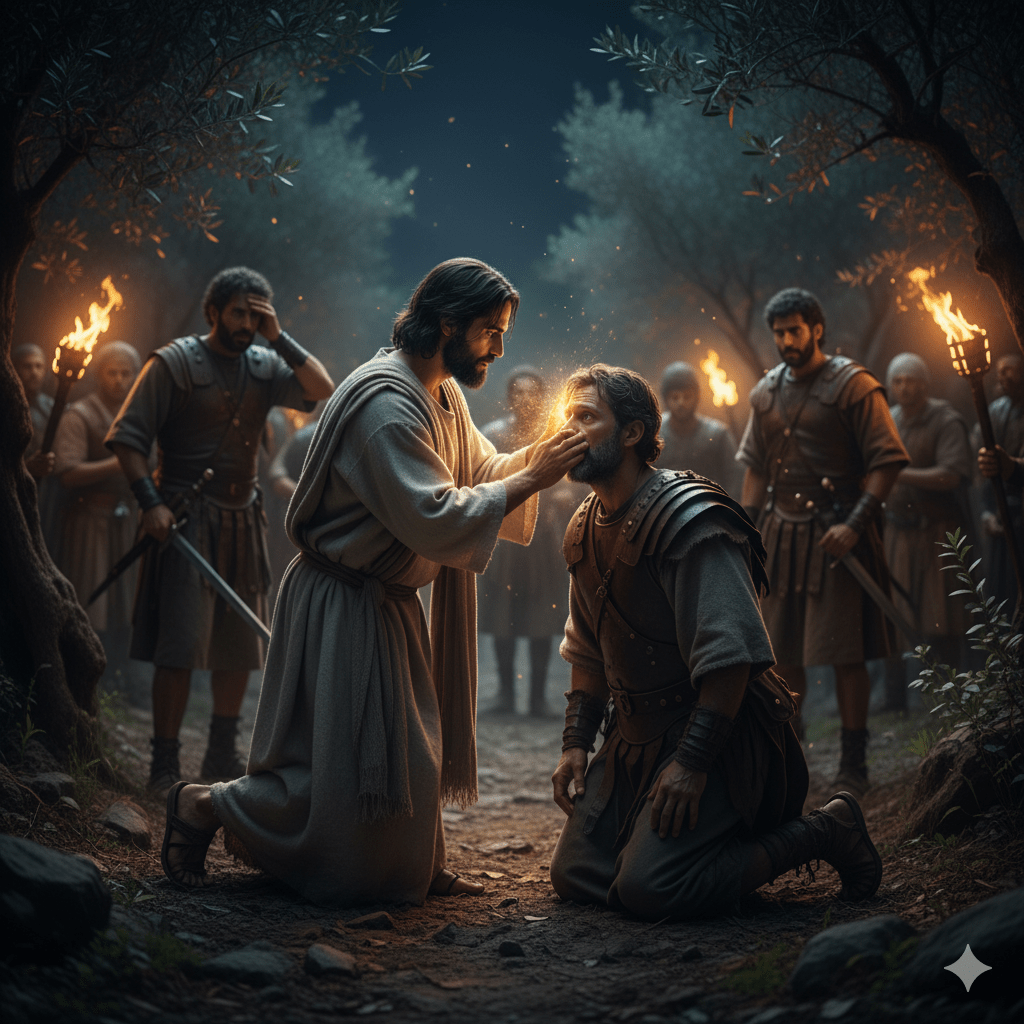
The events in Luke 22:50–51 and John 18:10–11 take place late at night in the Garden of Gethsemane, on the Mount of Olives, immediately after Yeshua’s time of deep prayer before His arrest. The setting follows the Last Supper, where He had shared bread and wine with His disciples, foretold His betrayal by Judas, and spoken of His impending suffering and death.
Yeshua knew that the time had come for His crucifixion — the fulfillment of His redemptive mission. After praying in great anguish, He submitted completely to the Father’s will, saying, “Not My will, but Yours be done” (Luke 22:42). At this moment, a crowd arrived led by Judas Iscariot, one of the twelve, who identified Yeshua to the authorities with a kiss — a gesture that symbolized betrayal in its most painful form.
The crowd consisted of Roman soldiers and temple guards sent by the chief priests and Pharisees. They carried torches, lanterns, and weapons (John 18:3), ready to arrest Yeshua as though He were a criminal. Yet Yeshua, fully aware of all that was to happen, stepped forward to meet them peacefully.
When the soldiers and officers approached, Yeshua asked, “Whom do you seek?” They replied, “Jesus of Nazareth.” Yeshua responded, “I am He,” and at His words, they drew back and fell to the ground — a moment revealing His divine authority (John 18:6). Despite this demonstration of power, He willingly surrendered, ensuring His disciples’ safety by saying, “If you seek Me, let these men go.”
At this tense moment, Simon Peter, driven by zeal and fear, drew his sword and struck Malchus, the servant of the high priest, cutting off his right ear (John 18:10). Peter’s impulsive act was likely an attempt to defend Yeshua or resist His arrest, misunderstanding the spiritual nature of the Kingdom.
However, Yeshua immediately rebuked him:
“Put your sword into its sheath; shall I not drink the cup which the Father has given Me?” (John 18:11).
In Luke’s account, Yeshua goes further — He touches the servant’s ear and heals him (Luke 22:51). This miraculous act of compassion at the very moment of His arrest displayed His divine mercy and rejection of violence. Even as He faced betrayal and injustice, He chose to heal and forgive.
The healing of Malchus’s ear marks Yeshua’s final miracle of healing before His crucifixion — a profound symbol of His mission to restore, not destroy. By healing the man who came to seize Him, Yeshua demonstrated love for His enemies, fulfilling His own teaching to “turn the other cheek.”
Peter’s sword symbolized human misunderstanding of God’s plan. Yeshua reminded him that the Kingdom of God advances not by force but by obedience and sacrifice. His words, “Shall I not drink the cup?” reflected His total submission to the Father’s will — the “cup” representing His suffering and atoning death.
This moment crystallized Yeshua’s identity as the Prince of Peace and the obedient Son of God, who refused violence and chose redemption. It contrasts human impulse with divine purpose — man seeks to fight with weapons, but Yeshua conquers through love, surrender, and truth.
Thus, the arrest scene reveals both the compassion of the Messiah and the divine necessity of His passion, showing that even in betrayal and suffering, Yeshua remained sovereign, merciful, and faithful to the mission of salvation.
 If any man serve me, let him follow me [John 12:26]