![If any man serve me, let him follow me [John 12:26]](https://onevisit.org/wp-content/uploads/2025/04/cropped-onevisit_final.jpg)
The miracle takes place early in Yeshua’s public ministry, shortly after He healed the centurion’s servant in Capernaum (Luke 7:1–10). That previous event already demonstrated His authority to heal from a distance and His willingness to respond to faith, even from a Gentile. Immediately after that, Luke records that Yeshua traveled to a small Galilean town called Nain, accompanied by His disciples and a large crowd.
Nain was a modest village located near Mount Tabor, about 25 miles southwest of Capernaum. The journey to Nain marks Yeshua’s expanding ministry beyond major centers like Capernaum, reflecting His compassion for people in all walks of life. Luke’s Gospel, more than any other, emphasizes Yeshua’s mercy toward the marginalized — the poor, the sick, women, and widows. This story perfectly fits that theme.
In Jewish society, a widow was among the most vulnerable individuals. The loss of her husband left her economically and socially dependent on her sons or relatives. In this case, the woman had lost her only son, leaving her utterly destitute. The funeral procession symbolizes not only personal grief but also the loss of security and hope.
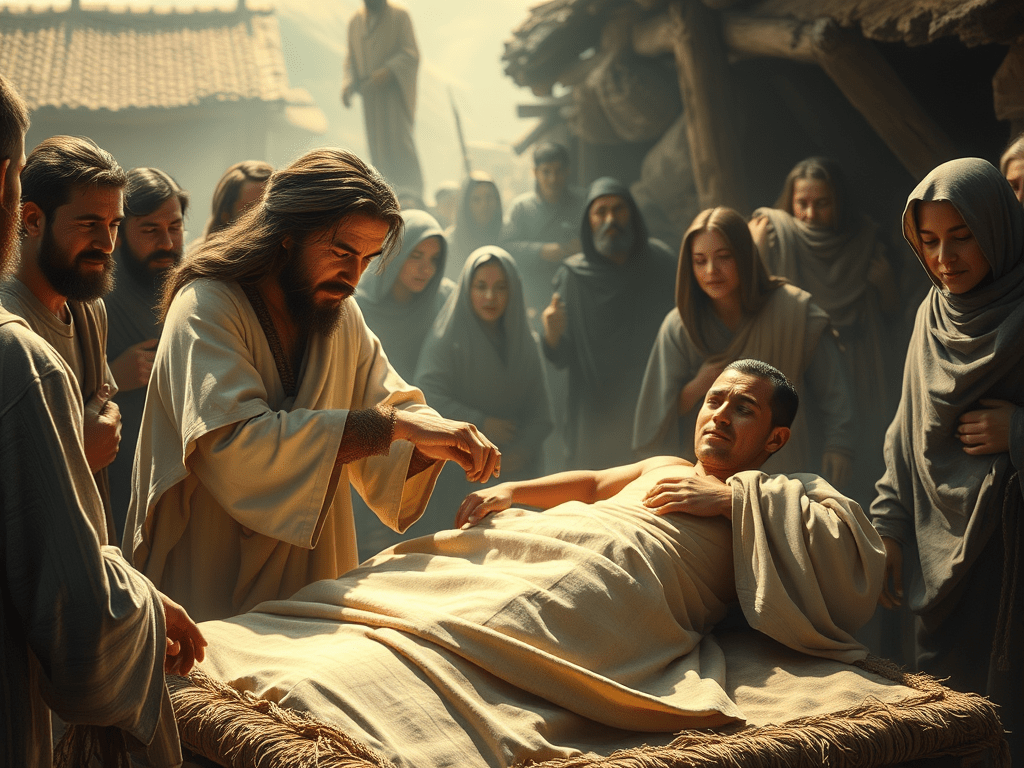
As Yeshua approached the gate of Nain, a funeral procession was coming out. The dead man was being carried on a bier (a type of stretcher used to transport bodies), surrounded by mourners. The scene was filled with sorrow and lamentation.
When Yeshua saw the grieving mother, Luke records that He was moved with compassion — the Greek term splagchnizomai denotes a deep, gut-level emotion. His response was not prompted by a request, as in many other miracles, but by His own initiative of mercy. He said to her, “Do not weep.” (Luke 7:13).
Then, approaching the bier, Yeshua touched it — a daring act, since touching the dead made one ceremonially unclean according to Jewish law (Numbers 19:11). However, Yeshua’s holiness overcomes impurity rather than being defiled by it. The bearers stopped, and Yeshua said, “Young man, I say to you, arise!” Immediately, the dead man sat up and began to speak. Yeshua then gave him back to his mother — a beautiful gesture showing both His divine authority and human tenderness.
The reaction of the people was one of awe, reverence, and praise. Fear seized everyone, and they glorified God, saying, “A great prophet has arisen among us!” and “God has visited His people!” (Luke 7:16). The miracle’s fame spread throughout Judea and the surrounding region.
This event reveals several profound truths:
- Yeshua’s Compassionate Heart – Unlike many miracles performed in response to requests, this one began purely from compassion. Yeshua’s mercy reaches those who cannot even ask for help.
- Authority Over Death – This is the first recorded resurrection miracle of Yeshua, showing His absolute power over life and death. Later, He would raise Jairus’ daughter and Lazarus, culminating in His own resurrection.
- A Foreshadowing of Salvation – The miracle prefigures Yeshua’s victory over sin and death for all humanity. His command, “Young man, arise,” echoes His future triumph at the empty tomb.
- Revelation of God’s Presence – The people’s cry, “God has visited His people,” identifies Yeshua’s ministry as the manifestation of divine visitation promised in the Old Testament.
In conclusion, the raising of the widow’s son at Nain stands as a moving testimony to the compassion and divine authority of Messiah. He is not distant from human suffering but enters into it, transforming mourning into joy and death into life. Through this act, Yeshua reveals Himself as the Lord who not only heals but restores life, proving that in Him, God truly visits His people with redeeming love.
 If any man serve me, let him follow me [John 12:26]