![If any man serve me, let him follow me [John 12:26]](https://onevisit.org/wp-content/uploads/2025/04/cropped-onevisit_final.jpg)
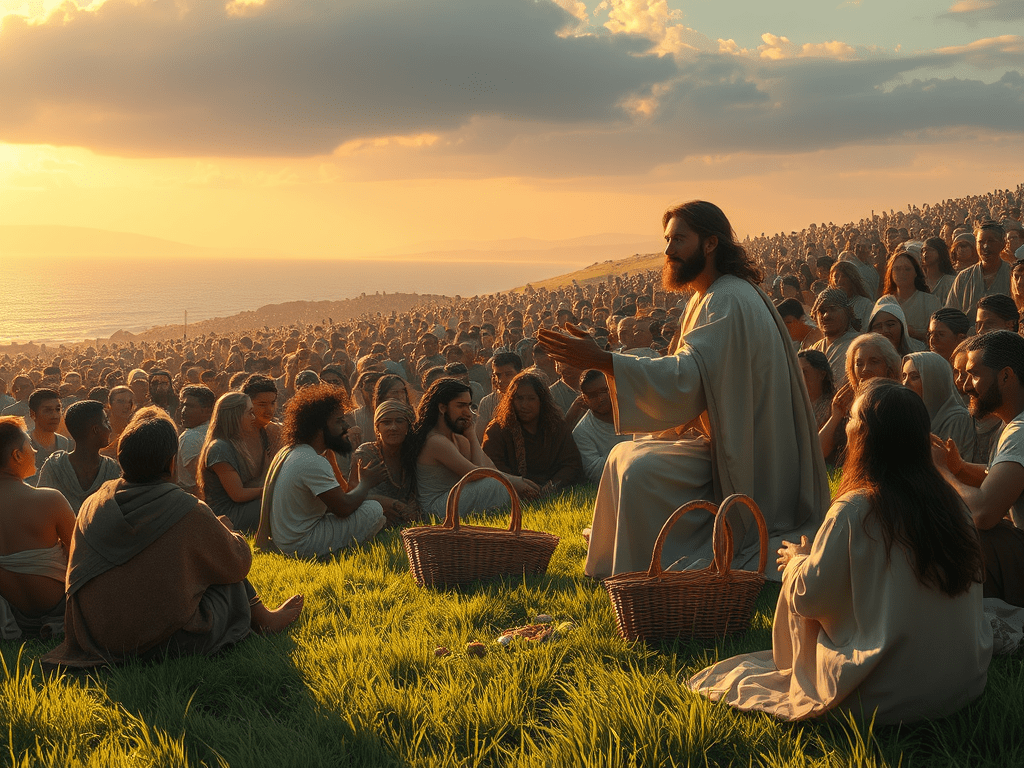
After the feeding of the five thousand (Matthew 14:13–21; Mark 6:30–44), Yeshua continued His ministry across Galilee and into predominantly Gentile regions. In the preceding chapters (Matthew 15:21–31; Mark 7:24–37), He had already ministered to non-Jews: healing the Syrophoenician woman’s daughter near Tyre and Sidon and restoring hearing and speech to a man in the Decapolis region.
The Decapolis was a federation of ten Hellenistic cities east of the Sea of Galilee — a culturally Gentile area. The miracles performed there demonstrated that God’s mercy extended beyond Israel to all nations. Thus, the feeding of the four thousand in this region serves as a deliberate act of inclusion: Yeshua not only teaches and heals Gentiles but also feeds them with the same compassion He showed the Jewish crowds earlier.
As Yeshua remained in the region, great crowds gathered around Him — people who had been with Him for three days listening to His teaching and witnessing His healings. They had run out of food and were too far from home to return safely. Moved by compassion, Yeshua said to His disciples, “I have compassion for these people; they have already been with Me three days and have nothing to eat. I do not want to send them away hungry, or they may collapse on the way.” (Matthew 15:32).
The disciples, however, again expressed uncertainty: “Where could we get enough bread in this remote place to feed such a crowd?” (v. 33). Their response revealed their forgetfulness of the earlier miracle of the five thousand. Yet Yeshua patiently guided them again.
He asked how many loaves they had, and they answered, “Seven, and a few small fish.” (Matthew 15:34; Mark 8:5–7). Yeshua instructed the crowd to sit down on the ground. Taking the seven loaves and fish, He gave thanks, broke them, and gave them to His disciples to distribute — the same pattern of blessing, breaking, and giving seen in the earlier miracle.
All the people ate and were satisfied, and afterward the disciples collected seven baskets of leftovers. The number seven often symbolizes fullness or completeness, hinting at the fullness of God’s grace reaching all people. About four thousand men, besides women and children, were fed. Afterward, Yeshua dismissed the crowd and got into the boat with His disciples, crossing to the region of Magadan (or Dalmanutha in Mark 8:10).
This miracle carries deep theological and symbolic meaning:
- Yeshua’s Compassion Is Universal – His concern for the hungry Gentile crowd reveals the inclusiveness of His love and mission. He does not discriminate between Jew and Gentile.
- Divine Provision in the Wilderness – Like God feeding Israel with manna, Yeshua provides sustenance in a desolate place, revealing Himself as the divine provider.
- Spiritual Foreshadowing – The miracle anticipates the Eucharist, where Yeshua offers Himself as the Bread of Life for all humanity.
- Faith and Dependence – The disciples’ hesitation contrasts with Yeshua’s steadfast trust in the Father’s provision. Through the act of giving thanks and sharing, Yeshua demonstrates that faith in God transforms scarcity into abundance.
- Symbolism of Numbers – The seven loaves and seven baskets suggest completeness — God’s perfect provision to all who come to Him in faith.
In conclusion, the feeding of the four thousand is not a mere repetition of the earlier miracle but a deliberate revelation of God’s inclusive mercy. It shows that the kingdom of God transcends boundaries and that Yeshua is the Bread of Life for all nations. His compassion knows no limits, and His provision satisfies both body and soul, calling all people — Jew and Gentile alike — to share in His abundance.
 If any man serve me, let him follow me [John 12:26]