![If any man serve me, let him follow me [John 12:26]](https://onevisit.org/wp-content/uploads/2025/04/cropped-onevisit_final.jpg)
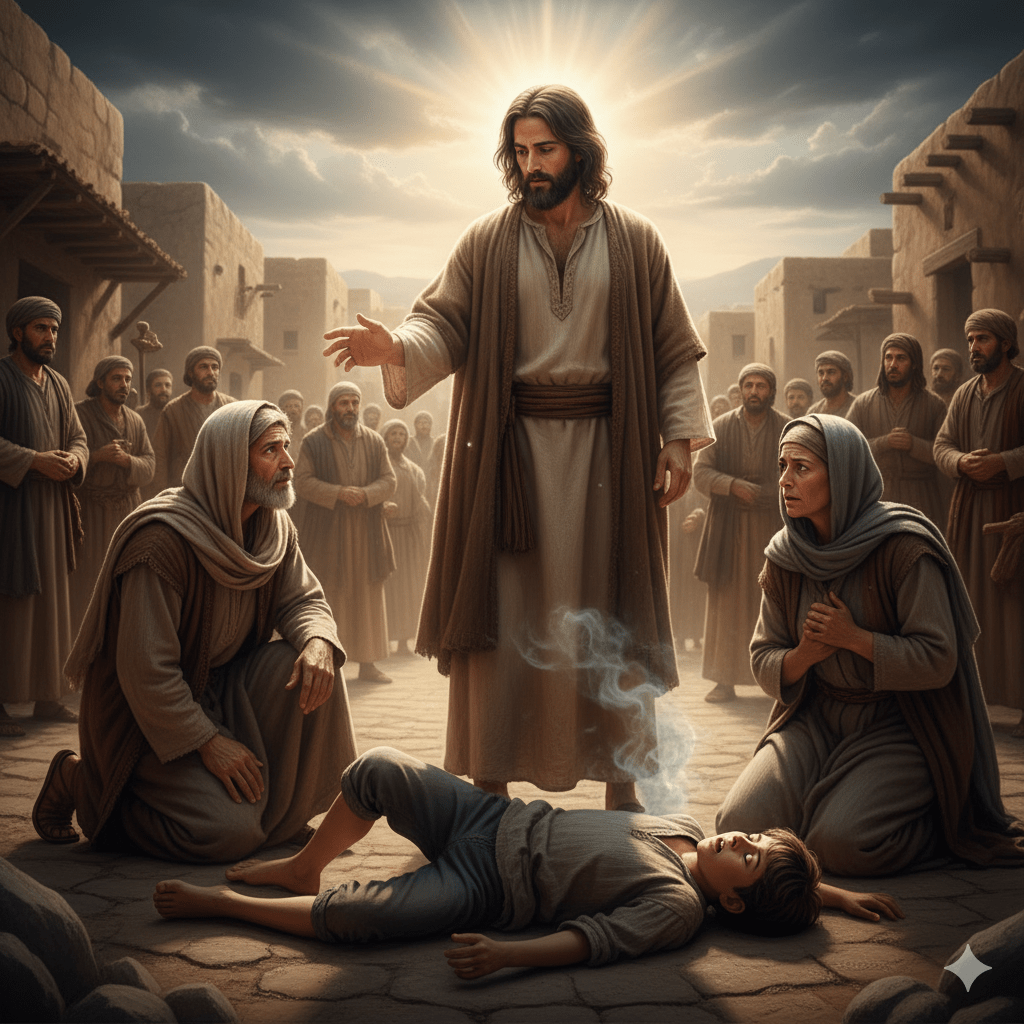
This dramatic healing takes place immediately after the Transfiguration (Mark 9:2–13; Matthew 17:1–13; Luke 9:28–36). Yeshua, having revealed His divine glory to Peter, James, and John on the mountain, comes down to find confusion, unbelief, and suffering below. The contrast between the glory of the mountaintop and the turmoil of the valley highlights the reality of Messiah’s mission — He is not only the glorified Son but also the compassionate Savior who enters human brokenness.
The scribes were arguing with the disciples who had failed to heal the boy. This failure becomes a lesson about faith, dependence on God, and the power of prayer. The story also reveals the disciples’ need for spiritual maturity and preparation for ministry after Yeshua’s coming departure.
As Yeshua approached the crowd, a man cried out, kneeling before Him: “Teacher, I beg You to look at my son, for he is my only child” (Luke 9:38). The boy was possessed by an evil spirit that caused convulsions, foaming at the mouth, and even attempts to destroy him (Mark 9:18, 22). The father had asked the disciples to cast out the demon, but they could not.
Yeshua responded with deep sorrow over the unbelief of that generation, saying, “O faithless generation, how long shall I be with you?” (Mark 9:19). Yet His compassion for the boy moved Him to act. The boy was brought before Yeshua, and as the spirit saw Him, it violently threw the child to the ground.
Yeshua asked the father how long this had been happening. The man replied that it had been since childhood and pleaded, “If You can do anything, have compassion on us and help us.” Yeshua replied, “If you can! All things are possible to him who believes.” The father cried out one of the most heartfelt prayers in Scripture: “I believe; help my unbelief!” (Mark 9:24).
Yeshua rebuked the unclean spirit, commanding it to leave and never return. The demon convulsed the boy again and came out, leaving him appearing lifeless, but Yeshua took him by the hand, and he arose completely healed (Mark 9:26–27). The people were amazed, and Luke records that “they were all astonished at the majesty of God” (Luke 9:43a).
Later, in private, the disciples asked Yeshua why they could not cast out the demon. Yeshua told them it was because of their lack of faith and dependence on prayer (and fasting, according to some manuscripts of Matthew 17:21 and Mark 9:29).
This powerful event teaches several vital lessons:
- Faith and Dependence – The disciples’ failure was not due to lack of authority but lack of faith and spiritual preparation. True power in ministry flows from trust and communion with God.
- Yeshua’s Compassion and Authority – His gentle care for the suffering boy and his father reveals His heart of mercy, while His command over the demon displays His supreme authority over evil.
- The Struggle of Faith – The father’s cry, “I believe; help my unbelief,” captures the tension of genuine faith mixed with human weakness. Yeshua honors even imperfect faith when it reaches out to Him.
- Prayer as the Channel of Power – Yeshua’s words, “This kind can come out only by prayer,” emphasize that spiritual victories are not achieved through technique but through dependence on God’s presence and power.
- From Glory to Ministry – The descent from the mount of glory to the valley of suffering symbolizes Yeshua’s mission — to bring divine power and compassion into the world’s darkness.
In summary, Mark 9:17–29, Matthew 17:14–21, and Luke 9:37–43a together reveal Yeshua as the all-powerful and compassionate Son of God, calling His followers to deeper faith, humility, and reliance on prayer. The story reminds believers that even a mustard seed of faith, anchored in Messiah, can move mountains and defeat the strongest powers of evil.
 If any man serve me, let him follow me [John 12:26]