![If any man serve me, let him follow me [John 12:26]](https://onevisit.org/wp-content/uploads/2025/04/cropped-onevisit_final.jpg)
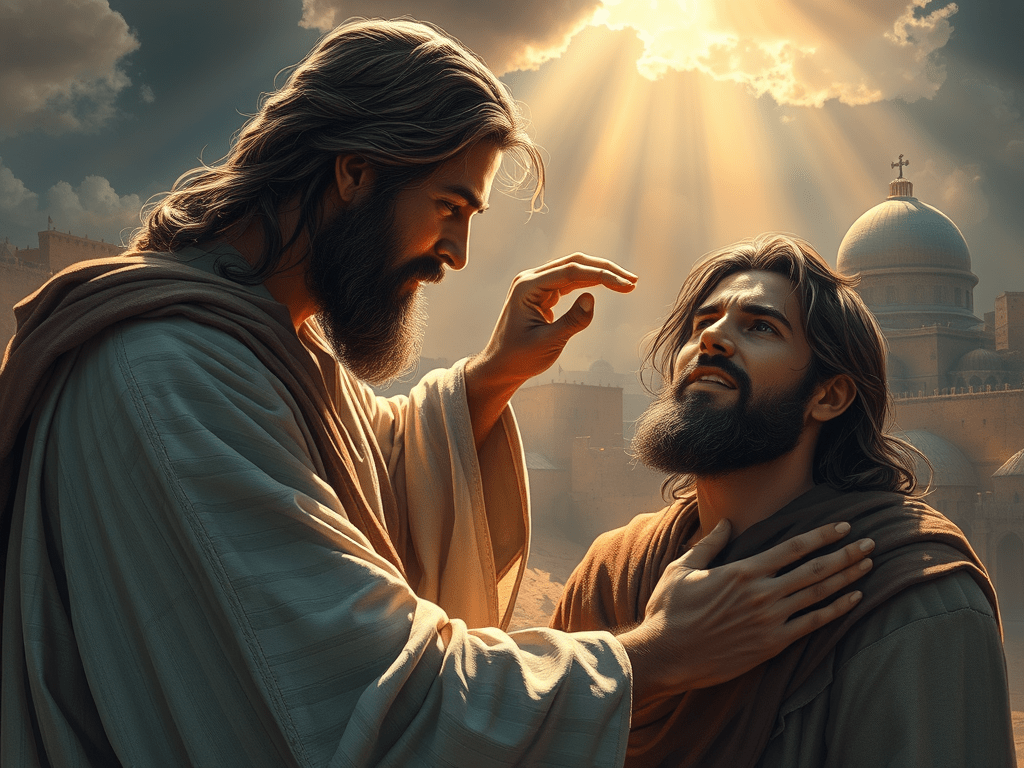
John 9 follows Yeshua’s confrontation with the Pharisees in John 8, where He declared, “Before Abraham was born, I am” (John 8:58). That claim of divine identity provoked attempts to stone Him. As Yeshua left the temple, He encountered a man blind from birth. This transition is significant: those who claimed to see (the Pharisees) were spiritually blind, while this physically blind man would come to see both physically and spiritually.
In John’s Gospel, miracles are called signs because they reveal deeper spiritual truths about who Yeshua is. The healing of the man born blind is the sixth sign, following the feeding of the five thousand and preceding the raising of Lazarus. It highlights Yeshua as “the light of the world” (John 9:5), the One who brings both physical sight and spiritual illumination.
As Yeshua and His disciples saw the blind man, the disciples asked, “Rabbi, who sinned, this man or his parents, that he was born blind?” (v. 2). They reflected the common Jewish belief that suffering was always caused by personal sin. Yeshua corrected them: “Neither this man nor his parents sinned, but this happened so that the works of God might be displayed in him” (v. 3). His answer reframed suffering as an opportunity for God’s glory.
Yeshua then declared, “I am the light of the world,” and performed an unusual act—He spat on the ground, made mud with the saliva, and applied it to the man’s eyes (v. 6). He told him, “Go, wash in the Pool of Siloam.” The man obeyed, washed, and came back seeing (v. 7).
The miracle caused astonishment and debate. Neighbors questioned whether he was the same man who had been blind. When they took him to the Pharisees, controversy erupted because the healing occurred on the Sabbath. Some Pharisees accused Yeshua of violating the Sabbath law, while others wondered how a sinner could perform such miracles (vv. 13–16).
The healed man, once interrogated, gave a powerful testimony: “One thing I do know. I was blind but now I see!” (v. 25). When pressed further, he boldly challenged the religious leaders’ unbelief, leading them to cast him out of the synagogue (v. 34).
Later, Yeshua found him again and revealed Himself as the “Son of Man.” The man responded with faith and worshiped Him (v. 38). The story concludes with Yeshua declaring, “For judgment I have come into this world, so that the blind will see and those who see will become blind” (v. 39). The Pharisees’ spiritual blindness stands in contrast to the man’s new vision of faith.
John 9:1–41 reveals profound theological and spiritual truths:
- Yeshua as the Light of the World – His healing of the blind man is a sign of His power to bring light into the darkness of sin and unbelief.
- Faith through Obedience – The man’s healing came through obedience to Yeshua’s command, illustrating that faith acts even without full understanding.
- Transformation and Testimony – The man moved from physical blindness to spiritual sight, from beggar to bold witness. His growing faith contrasts with the Pharisees’ hardened rejection.
- Suffering and God’s Glory – The man’s lifelong blindness became a stage for divine revelation, teaching that suffering can serve a greater purpose.
- Judgment and Revelation – Yeshua’s presence exposes hearts: those who admit their blindness receive sight; those who claim to see remain blind.
In summary, John 9 is not merely a story of physical healing but of revelation and faith. It illustrates the journey from darkness to light and challenges every reader to consider whether they truly see Yeshua for who He is—the Light of the world, the One who gives sight to the blind and opens hearts to truth.
 If any man serve me, let him follow me [John 12:26]