![If any man serve me, let him follow me [John 12:26]](https://onevisit.org/wp-content/uploads/2025/04/cropped-onevisit_final.jpg)
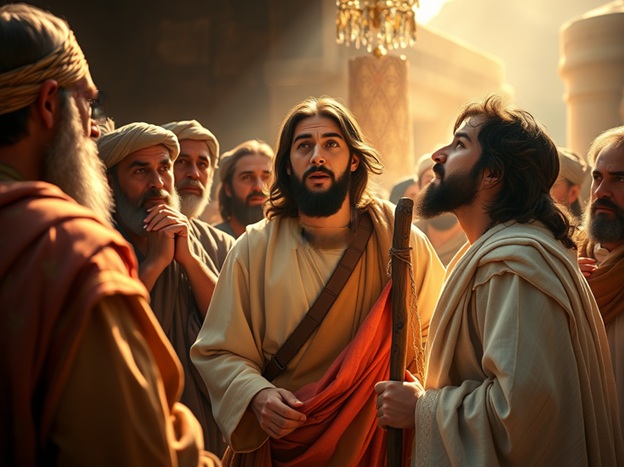
These passages describe a pivotal confrontation between Yeshua and the religious leaders regarding the source of His power. The event occurs after a series of healings and exorcisms in which Yeshua demonstrated divine authority. In Matthew 12, the account follows disputes about the Sabbath, where opposition from the Pharisees had already intensified. In Mark 3, it comes after the calling of the Twelve, showing the growing tension between Yeshua’s ministry and His opponents. In Luke 11, it appears during His broader teaching on the kingdom of God.
At this point in His ministry, Yeshua was becoming increasingly well-known, not only for His teaching but for His miraculous power over demons. The religious leaders, unable to deny His miracles, began questioning their source. Their accusation that He cast out demons by the power of Beelzebul (a name associated with Satan) reveals the hardness of their hearts and foreshadows the growing hostility that would lead to His death.
In each Gospel, Yeshua heals a man possessed by a demon that had made him blind and mute (Matthew 12:22; Luke 11:14). The man is immediately restored—he can see and speak. The crowd is amazed, and in Matthew’s account they even wonder aloud, “Can this be the Son of David?”—a Messianic title (Matthew 12:23).
But the Pharisees and scribes, unwilling to accept Him as Messiah, accuse Yeshua of casting out demons by the power of Beelzebul, the “prince of demons” (Matthew 12:24; Mark 3:22; Luke 11:15). This was a serious charge, suggesting that His power came not from God but from Satan.
Yeshua responds with a logical and spiritual rebuttal. First, He points out the absurdity of their claim: “Every kingdom divided against itself is laid waste” (Matthew 12:25; Mark 3:24; Luke 11:17). If Satan were casting out his own demons, his kingdom would collapse. The very fact that demons were being expelled showed that God’s kingdom was advancing.
He then explains that His works prove the presence of the “finger of God” (Luke 11:20) or “Spirit of God” (Matthew 12:28). By freeing people from demonic oppression, Yeshua demonstrated that God’s reign was breaking into the world. He uses the image of binding a strong man (Satan) in order to plunder his house (rescue people from bondage).
Finally, Yeshua
issues a solemn warning: attributing the work of the Holy Spirit to Satan is blasphemy against the Spirit, an unforgivable sin (Matthew 12:31–32; Mark 3:28–30). Unlike other sins that can be forgiven through repentance, this sin represents a deliberate, hardened rejection of God’s saving work and the Spirit’s testimony about Messiah.
These passages highlight several critical truths:
- Yeshua’s Authority – His power over demons reveals the in-breaking of God’s kingdom and confirms His identity as the Messiah.
- Divided Allegiances – Yeshua makes it clear: “Whoever is not with me is against me” (Luke 11:23). Neutrality toward Him is impossible.
- The Danger of Rejection – The Pharisees’ accusation shows the peril of spiritual blindness. To reject Yeshua’s works as demonic is to oppose the Spirit’s testimony.
- The Kingdom Conflict – Yeshua portrays His ministry as a battle between God’s kingdom and Satan’s dominion. His victories over demons are signs that Satan is being overthrown.
- The Warning of the Unforgivable Sin – Persistent rejection of Messiah and attributing God’s work to evil reflects a hardened heart beyond repentance.
In summary, Matthew 12:22–32, Mark 3:20–30, and Luke 11:14–23 underscore the seriousness of responding rightly to Yeshua. His miracles testify to the arrival of God’s kingdom, demanding a decision: either acknowledge Him as Messiah or oppose Him. The accounts remind us that recognizing the Spirit’s work in Messiah is central to true faith and salvation.
 If any man serve me, let him follow me [John 12:26]