![If any man serve me, let him follow me [John 12:26]](https://onevisit.org/wp-content/uploads/2025/04/cropped-onevisit_final.jpg)
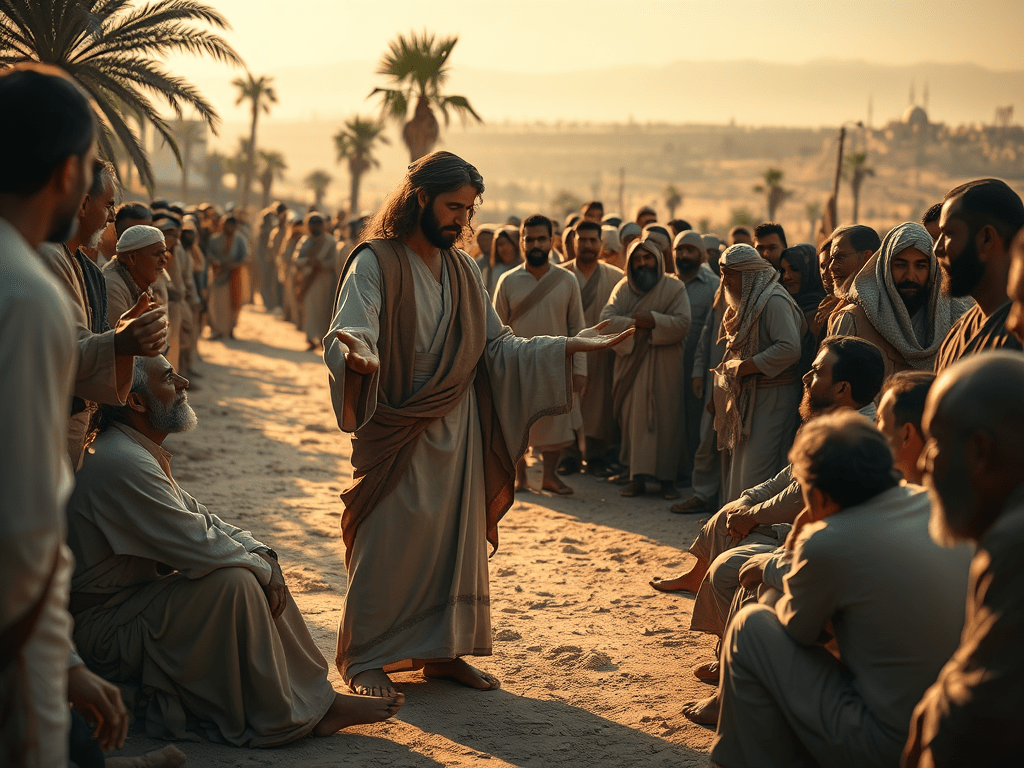
This healing event occurs near Jericho as Yeshua is on His final journey to Jerusalem, just before His triumphal entry and the Passion. The timing is crucial: Yeshua is about to suffer and die, yet His ministry of compassion continues. The miracle functions not only as an act of mercy but also as a symbolic sign of spiritual sight—those who recognize Yeshua as the Son of David are given vision, while many in Israel remain spiritually blind.
Each Gospel provides slightly different details. Matthew records two blind men (20:29–34), Mark mentions one (10:46–52) named Bartimaeus, and Luke also presents one (18:35–43). These are not contradictions but variations in perspective: Matthew tends to double witnesses, Mark emphasizes the personal story of Bartimaeus, and Luke highlights the dramatic encounter as Yeshua approaches Jericho. Together, they give a fuller picture.
The title “Son of David” used by the blind men is especially important in context. It is a Messianic title, showing that even the physically blind can perceive who Yeshua truly is. This confession contrasts with the spiritual blindness of many religious leaders.
As Yeshua drew near to or left Jericho (depending on the account), blind beggars were sitting by the roadside. Hearing that Yeshua of Nazareth was passing by, they began to cry out: “Have mercy on us, Son of David!” (Matthew 20:30; Mark 10:47; Luke 18:38). Their plea was both desperate and filled with faith.
The crowd tried to silence them, considering them nuisances or unworthy of attention. Yet they cried out all the more loudly, refusing to let the opportunity pass. Their persistence demonstrates genuine faith and determination.
Yeshua stopped, stood still, and called them over. In Mark’s account, the crowd suddenly shifted from rebuking to encouraging Bartimaeus: “Take heart, get up; He is calling you.” Bartimaeus threw off his cloak—a symbolic act of leaving behind his old life—and came to Yeshua.
Yeshua asked, “What do you want me to do for you?” (Mark 10:51). The blind men responded simply: “Lord, let our eyes be opened” (Matthew 20:33), or “Rabbi, I want to see.” Their request reveals both physical need and a deeper longing for wholeness.
Moved with compassion, Yeshua touched their eyes (Matthew) or spoke a word (Mark and Luke): “Go, your faith has made you well.” Immediately, their sight was restored. In response, they followed Yeshua, glorifying God, and the people who witnessed it also praised God.
This miracle highlights several important truths:
- Faith that Perseveres – The blind men refused to be silenced. Their persistence models true faith that overcomes opposition and presses into God’s mercy.
- Messianic Recognition – By calling Yeshua “Son of David,” they acknowledged Him as the promised King. Their confession is significant at this point in the Gospel, as Yeshua is about to be hailed with the same title in Jerusalem.
- Compassion of Yeshua – Despite being on His way to the cross, Yeshua stopped to show mercy to marginalized beggars. His compassion is never hindered by His own mission.
- Healing and Discipleship – The blind men not only received sight but also chose to follow Yeshua. Healing led to worship and discipleship, showing that true encounters with Messiah transform lives.
- Contrast of Sight and Blindness – Those physically blind saw Yeshua’s identity clearly, while many who had physical sight remained spiritually blind. This miracle thus serves as both literal healing and spiritual metaphor.
In summary, Matthew 20:29–34, Mark 10:46–52, and Luke 18:35–43 reveal Yeshua as the compassionate Son of David who responds to persistent faith, restores sight, and invites the healed into discipleship. The story points to the deeper truth that recognizing Yeshua for who He is brings true vision and new life.
 If any man serve me, let him follow me [John 12:26]