![If any man serve me, let him follow me [John 12:26]](https://onevisit.org/wp-content/uploads/2025/04/cropped-onevisit_final.jpg)
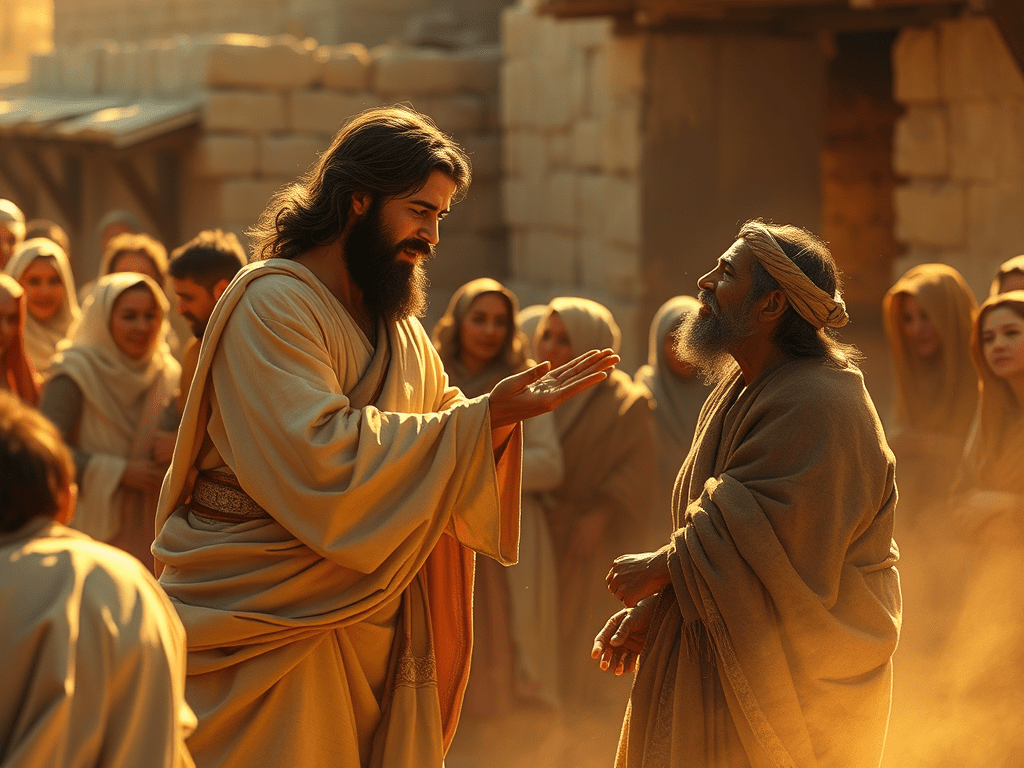
Matthew 9:32–34 records the healing of a mute man possessed by a demon. This short passage comes at the end of a series of miracles in Matthew chapters 8 and 9, where Yeshua demonstrates His authority over nature, sickness, sin, and demonic powers. These chapters show a progression of miracles designed to reveal His identity as the promised Messiah.
Immediately before this story, Yeshua had healed two blind men who cried out to Him as “Son of David” (Matthew 9:27–31). Their recognition of Him as Messiah contrasts sharply with the unbelief of the Pharisees in the next verses. Matthew places this account strategically to show both the compassion and power of Yeshua and the increasing hostility of the religious leaders.
In the broader context, Matthew 9 concludes with Yeshua’s compassion for the crowds as sheep without a shepherd (vv. 35–38), setting the stage for the commissioning of the Twelve in Matthew 10. Thus, this healing is part of Matthew’s theme of growing division: while the common people marveled at His works, the religious authorities attributed His power to Satan.
As Yeshua was leaving from the healing of the blind men, some people brought to Him a man who was mute because of demonic possession (Matthew 9:32). This condition was not a mere speech impediment but a bondage caused by an evil spirit. In the worldview of the time, such cases were considered hopeless since exorcists relied on knowing the name of the spirit, and a mute man could not speak. This makes the healing particularly striking—it was something considered beyond human help.
Yeshua cast out the demon, and the man immediately spoke (v. 33). No elaborate ritual or formula was required; the authority of Yeshua’s word was enough. The crowd, witnessing this, was amazed and said, “Never was anything like this seen in Israel.” Their response was one of wonder and recognition that God’s power was uniquely at work in Him.
However, the Pharisees offered a completely different interpretation. Instead of acknowledging God’s hand, they said: “He casts out demons by the prince of demons” (v. 34). This accusation shows their growing resistance and hostility. Unable to deny the reality of the miracle, they attempted to discredit its source by claiming that Yeshua’s authority came from Satan rather than from God.
This brief but powerful episode highlights several key lessons:
- Yeshua’s Authority Over Demons – With a single command, He freed a man from bondage and restored his ability to speak. This demonstrates that no case is too difficult for His power.
- Compassion and Restoration – Yeshua not only delivered the man but restored his voice, symbolizing freedom and renewed participation in community and worship. His healings always brought wholeness.
- The People’s Amazement – The crowds recognized that nothing like this had ever been seen in Israel. Their response reflects openness to God’s work and a sense that the Messianic age had dawned.
- Religious Opposition – The Pharisees, unwilling to accept Yeshua, attributed His power to the devil. This reveals the hardness of their hearts and foreshadows the later charge of blasphemy against the Holy Spirit (Matthew 12:22–32).
- Division of Responses – The same miracle produced faith and amazement in some, and hostility and rejection in others. This shows that encounters with Yeshua always demand a response—either acceptance or rejection.
In summary, Matthew 9:32–34 underscores the authority of Yeshua to deliver from demonic oppression, the compassion He shows to the broken, and the sharp contrast between the joyful response of the people and the hardened unbelief of the Pharisees. It marks a turning point where opposition intensifies, preparing the way for the mission of the disciples and the unfolding of Yeshua’s ministry toward the cross.
 If any man serve me, let him follow me [John 12:26]