![If any man serve me, let him follow me [John 12:26]](https://onevisit.org/wp-content/uploads/2025/04/cropped-onevisit_final.jpg)
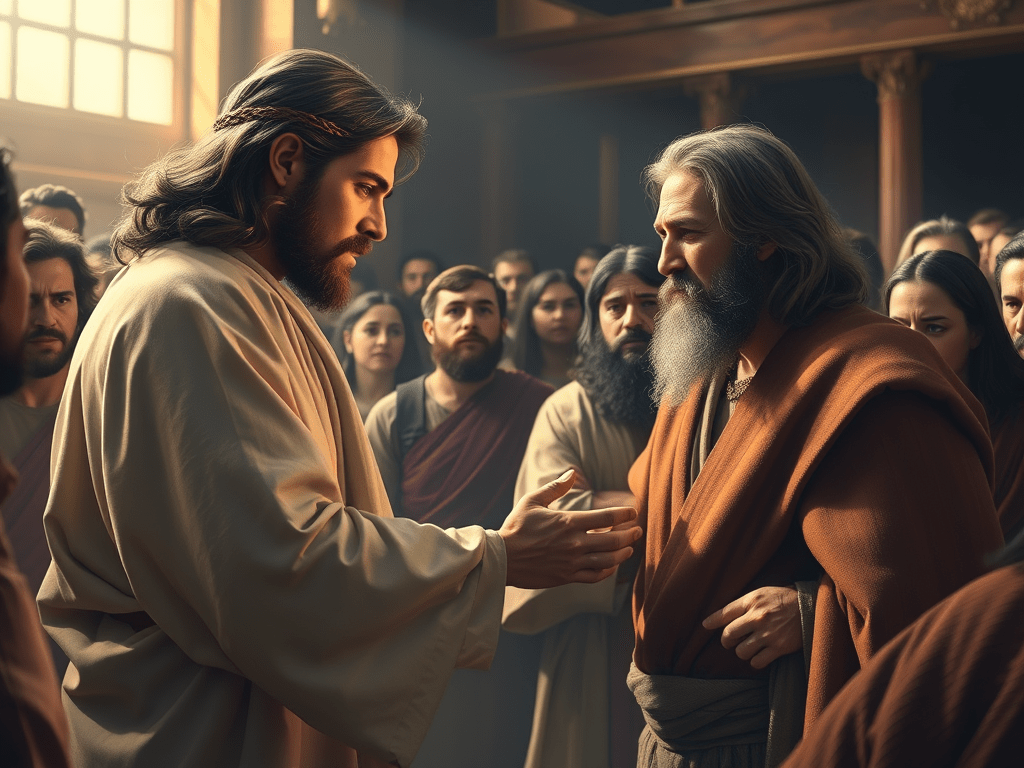
The healing of the man with the withered hand is recorded in all three Synoptic Gospels and represents a key moment of conflict between Yeshua and the religious leaders.
In Matthew 12:9–14, the event follows immediately after Yeshua’s teaching about the Sabbath (Matthew 12:1–8), where He declared Himself “Lord of the Sabbath.” Matthew’s account highlights the Pharisees’ hostility and their plotting to destroy Him after this incident.
In Mark 3:1–6, it occurs early in Yehua’s Galilean ministry, after several clashes with religious leaders over fasting, healing, and Sabbath observance. Mark emphasizes the hardness of the Pharisees’ hearts and notes that their opposition escalated to conspiring with the Herodians.
In Luke 6:6–11, Luke places the healing after another Sabbath controversy (the disciples plucking grain, Luke 6:1–5). He stresses Yeshua’s boldness in challenging the religious leaders publicly and underscores His authority to define the true purpose of the Sabbath.
The context in all three accounts shows a growing conflict: Yeshua, who embodies the mercy and freedom of God’s Kingdom, confronts the rigid legalism of the Pharisees.
On a Sabbath, Yeshua entered the synagogue, where a man with a withered hand was present (Matthew 12:9; Mark 3:1; Luke 6:6). The Pharisees and scribes were watching carefully, hoping to accuse Him of violating the Sabbath if He healed. Their motive was not genuine concern for the Law or the man, but a desire to trap Yeshua.
Yeshua, knowing their thoughts, brought the issue into the open. In Matthew’s account, He asked: “Is it lawful to heal on the Sabbath?” (Matthew 12:10). He illustrated with an example: if one of them had a sheep fall into a pit on the Sabbath, they would rescue it. How much more valuable is a man than a sheep? Therefore, it is lawful to do good on the Sabbath (Matthew 12:11–12).
Mark and Luke record Yeshua’s command for the man to stand in the midst of everyone, making the situation public (Mark 3:3; Luke 6:8). He then asked: “Is it lawful on the Sabbath to do good or to do harm, to save life or to destroy it?” (Mark 3:4; Luke 6:9). His question exposed their hypocrisy: refusing to heal was itself a form of harm.
When they remained silent, Yeshua looked around at them with anger and grief over their hardened hearts (Mark 3:5). He then said to the man: “Stretch out your hand.” The man obeyed, and his hand was completely restored.
Instead of rejoicing at this miracle, the Pharisees were filled with rage. Matthew notes they “went out and conspired against Him, how to destroy Him” (Matthew 12:14). Mark adds that they joined forces with the Herodians, normally political rivals, united by their opposition to Jesus (Mark 3:6). Luke likewise emphasizes their fury and plotting (Luke 6:11).
This passage demonstrates several vital truths:
- True Meaning of the Sabbath – Yeshua revealed that the Sabbath was not about legalistic restrictions but about life, mercy, and restoration. Doing good aligns with God’s intention for His people to find rest and wholeness.
- Value of Human Life – By comparing the rescue of a sheep to the healing of a man, Yeshua affirmed the surpassing worth of human beings in God’s eyes.
- Exposure of Hypocrisy – The Pharisees claimed to defend God’s Law, yet their refusal to acknowledge mercy and lack of understanding the true sense of God’s Law, and showed their spiritual blindness. Their concern for rules overshadowed compassion.
- Yeshua’s Authority and Compassion – With a simple word, Yeshua restored the man, demonstrating both divine power and deep compassion. He stood boldly against opposition, showing that His mission was to bring life and healing.
- Escalation of Conflict – The response of the Pharisees reveals the growing hostility that would eventually lead to the cross. Instead of rejoicing in God’s work, they hardened their hearts in opposition.
In summary, Matthew, Mark, and Luke present this miracle as a turning point: Yeshua, the Lord of the Sabbath, demonstrates that God’s law is fulfilled in mercy, not legalism. The healing of the man with the withered hand exposes the contrast between the life-giving ministry of Messiah and the death-dealing hostility of His opponents.
 If any man serve me, let him follow me [John 12:26]