![If any man serve me, let him follow me [John 12:26]](https://onevisit.org/wp-content/uploads/2025/04/cropped-onevisit_final.jpg)
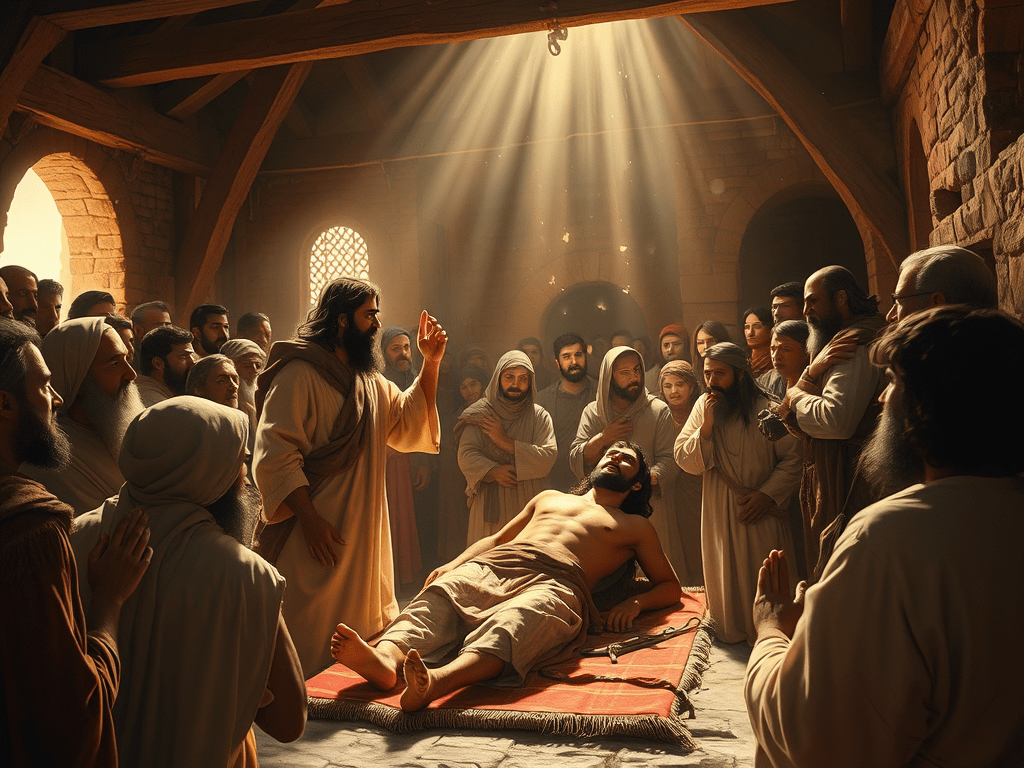
The healing of the paralytic is one of the most striking miracles in the Synoptic Gospels because it not only reveals Yeshua’s power to heal but also His authority to forgive sins.
In Matthew 9:1–8, Yeshua has just returned to Capernaum after healing the Gadarene demoniacs. Matthew highlights Yeshua’s authority in both word and deed, showing Him as the One who fulfills God’s promises.
In Mark 2:1–12, this episode comes after a series of healings and exorcisms in Capernaum. Crowds are already gathering in great numbers, and Mark emphasizes both the public nature of the miracle and the controversy it sparks with the scribes.
In Luke 5:17–26, the setting includes Pharisees and teachers of the law from all over Galilee, Judea, and Jerusalem. Luke points out that “the power of the Lord was present to heal” (v. 17), setting the stage for a demonstration of divine authority.
Thus, the context shows that this miracle is not only about healing but also about confronting religious opposition and revealing the deeper reality of Yeshua’s identity as the Son of Man with authority to forgive sins.
In all three accounts, Yeshua is teaching in a crowded house in Capernaum. The house is so packed that no one can get inside. Meanwhile, a group of men arrive carrying a paralyzed man on a mat, determined to bring him to Yeshua.
Unable to enter through the door, they take an extraordinary step: climbing onto the roof, opening a hole, and lowering the man down right in front of Yeshua (Mark 2:4; Luke 5:19). Their persistence demonstrates faith in action.
When Yeshua sees their faith, He speaks not first to the man’s physical condition but to his spiritual need: “Son, your sins are forgiven” (Matthew 9:2; Mark 2:5; Luke 5:20). This statement provokes outrage from the scribes and Pharisees, who reason inwardly that only God can forgive sins.
Knowing their thoughts, Yeshua confronts them: “Which is easier, to say, ‘Your sins are forgiven,’ or to say, ‘Rise and walk’?” (Matthew 9:5; Mark 2:9; Luke 5:23). To prove His authority, He commands the paralytic: “Rise, take up your bed, and go home.” Immediately, the man stands up, picks up his mat, and walks in full view of everyone.
The crowds respond with amazement and glorify God. Matthew notes, “They marveled and glorified God, who had given such authority to men” (Matthew 9:8). Mark and Luke stress the astonishment and praise that filled the people as they witnessed God’s power.
This passage teaches several profound truths:
- Faith in Action – The determination of the friends demonstrates that true faith is persistent, bold, and creative in seeking Yeshua. Their effort became the channel for the paralytic’s healing.
- Authority to Forgive Sins – Physical healing confirmed the greater reality of spiritual forgiveness. Yeshua’s words show that He is not only a miracle-worker but also the divine Son of Man with the authority of God Himself.
- Confrontation with Religious Leaders – This event marks an escalation in the conflict between Yeshua and the scribes/Pharisees. They saw blasphemy, but Yeshua revealed truth: the Kingdom had come in His person.
- Glory to God – The miracle led to public praise, showing that the purpose of Yeshua’s works was to direct people to God’s glory and invite them into deeper faith.
In summary, the healing of the paralytic reveals that Yeshua is more than a healer—He is the Savior who forgives sins, restores lives, and carries divine authority. It challenges readers to approach Him in faith, trusting not only in His power to heal bodies but also in His power to forgive and transform hearts.
 If any man serve me, let him follow me [John 12:26]