![If any man serve me, let him follow me [John 12:26]](https://onevisit.org/wp-content/uploads/2025/04/cropped-onevisit_final.jpg)
The Gospel of John highlights Yeshua’s (Jesus’) identity as the Son of God through signs, miracles, and discourses. By the time we reach John 5, Yeshua has already performed miraculous works such as turning water into wine (John 2:1–11), cleansing the temple (John 2:13–22), and healing the nobleman’s son (John 4:46–54). Each sign points to His divine authority and the revelation of God’s kingdom.
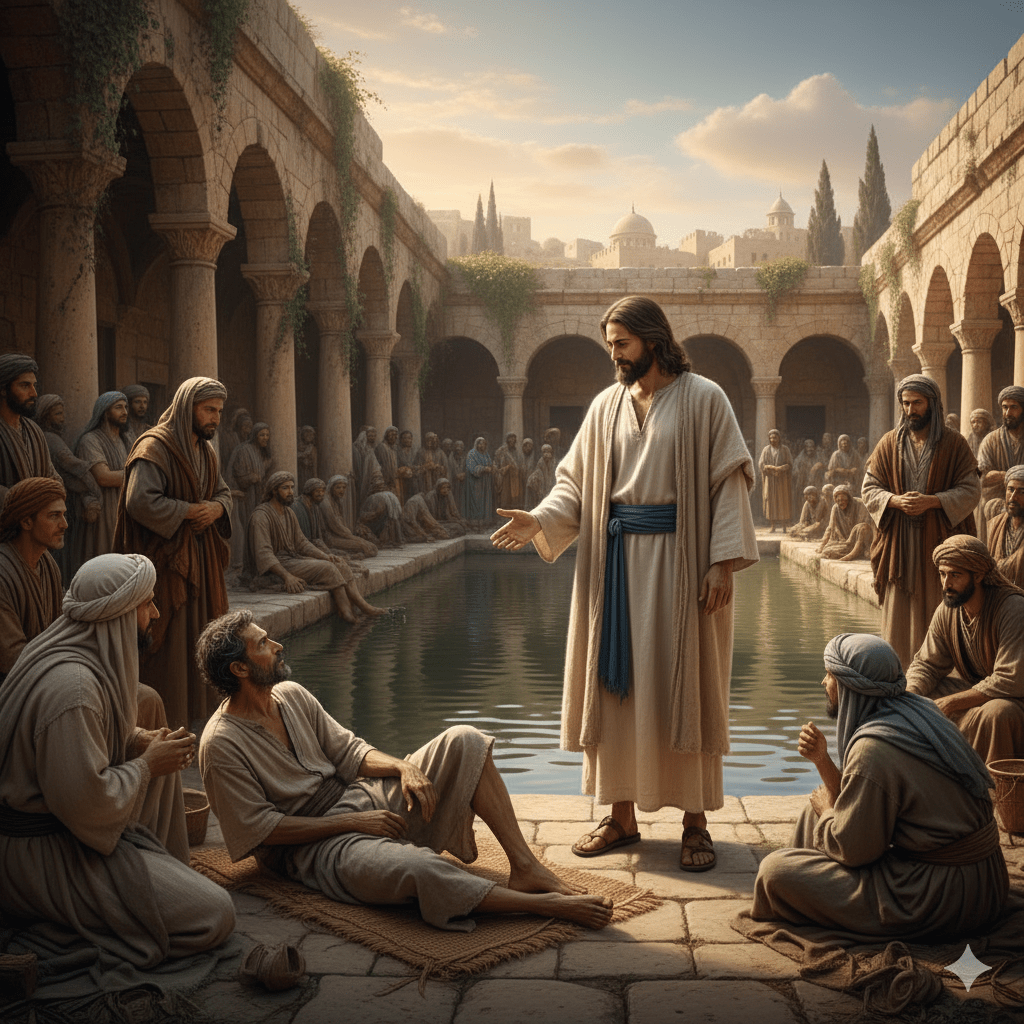
John 5 begins with Yeshua’s going up to Jerusalem for a Jewish feast. Near the Sheep Gate was the pool of Bethesda, surrounded by five porches, where a multitude of sick, blind, lame, and paralyzed people gathered, hoping to be healed. According to tradition, an angel would stir the waters, and the first person to enter afterward would be healed (John 5:3–4, though verse 4 is omitted in many manuscripts). This setting demonstrates the desperation of people seeking physical healing and highlights the insufficiency of human means compared to Messiah’s power.
Among the gathered crowd, Yeshua noticed a man who had been an invalid (hand an infirmity) for thirty-eight years (John 5:5). This man had waited for healing, yet was unable to enter the pool in time, lacking anyone to help him (John 5:7). Yeshua, seeing his long condition, asked a profound question: “Wilt thou be made whole?” (John 5:6). The man explained his helplessness, but Yeshua did not rely on the pool or traditions—He spoke directly with divine authority: “Rise, take up thy bed, and walk.” (John 5:8). Immediately, the man was healed, took up his bed, and walked (John 5:9).
However, this miracle stirred controversy because it was performed on the Sabbath. The Jewish leaders objected, telling the man that carrying his bed violated Sabbath law (John 5:10). When questioned, the healed man explained that the one who healed him commanded him to carry his bed, though he did not yet know it was Yeshua (John 5:11–13).
Later, Yeshua found the man in the temple and instructed him: “Behold, thou art made whole: sin no more, lest a worse thing come unto thee.” (John 5:14). This shows that Yeshua not only heals the body but also calls people to spiritual wholeness. The man then reported to the Jews that it was Yeshua who healed him (John 5:15).
This led the Jewish leaders to persecute Yeshua, accusing Him of breaking the Sabbath (John 5:16). Yeshua responded with a profound statement: “My Father worketh hitherto, and I work.” (John 5:17). By this, He declared His unity with the Father, revealing that His works are the continuation of God’s divine activity. The Jews understood this as a claim to equality with God, intensifying their desire to kill Him (John 5:18).
John 5:1–18 reveals Yeshua as the true source of healing and life, surpassing traditions and limited human expectations. The healing at Bethesda demonstrates His compassion and power, while His command to “sin no more” shows His concern for spiritual restoration. The controversy over the Sabbath highlights that Yeshua is Lord of the Sabbath, affirming His divine authority.
Ultimately, this passage sets the stage for deeper revelations of Yeshua’s identity in John 5:19–47, where He teaches about His unity with the Father, His authority to give life, and His role as Judge. Thus, this event not only testifies to His miraculous power but also confronts the religious leaders with the truth of His divine Sonship.
 If any man serve me, let him follow me [John 12:26]