![If any man serve me, let him follow me [John 12:26]](https://onevisit.org/wp-content/uploads/2025/04/cropped-onevisit_final.jpg)
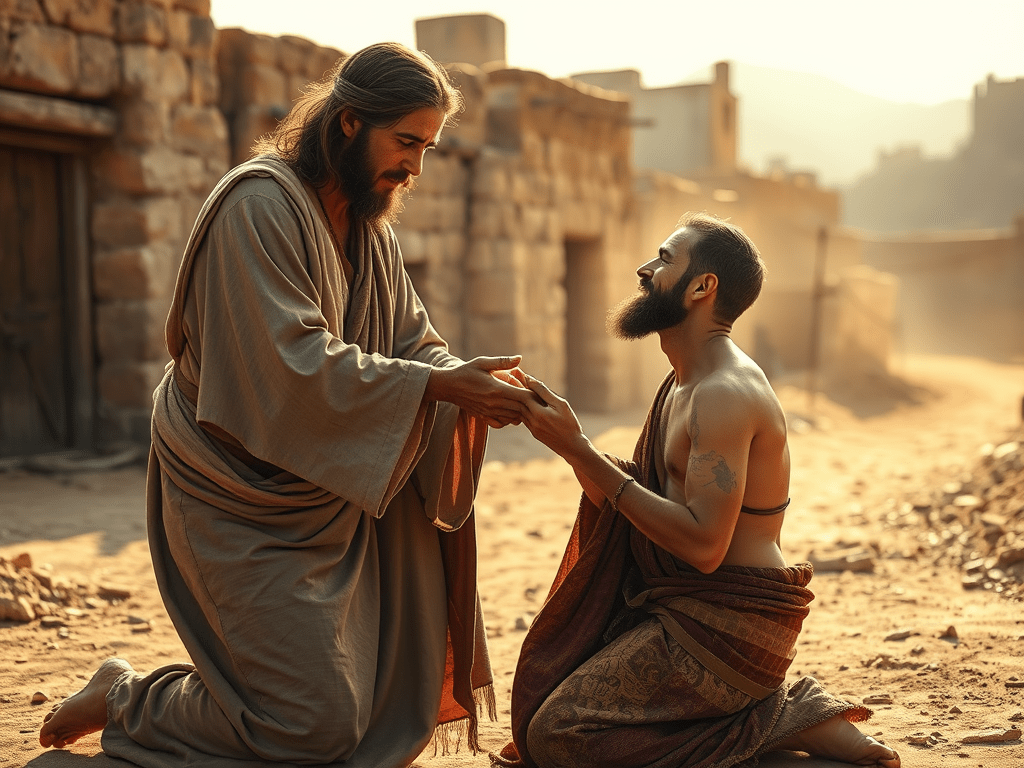
In the Gospels of Matthew, Mark, and Luke, the healing of the leper is a powerful testimony of Yeshua’s (Jesus’) authority, compassion, and fulfillment of the Law. Each Evangelist records the account with unique emphases but points to the same truth: the Messiah brings cleansing to the unclean.
In Matthew 8:1–4, the healing takes place immediately after the Sermon on the Mount (Matthew 5–7). As Yeshua descends from the mountain, large crowds follow Him, and the first miracle Matthew highlights is the cleansing of a leper. This connects His authoritative teaching with His authoritative power to heal.
In Mark 1:40–45, the account follows the early Galilean ministry where Yeshua is already preaching, healing, and casting out demons. Mark’s Gospel stresses the spreading fame of Yeshua, yet also His desire for secrecy until the right time.
In Luke 5:12–16, the setting is a city where Yeshua is teaching and ministering. Luke, the physician, carefully describes the man as being “full of leprosy,” highlighting the severity of the disease. Luke also stresses Yeshua’s practice of withdrawing to pray after ministering.
Thus, the context shows Yeshua not only as a powerful miracle-worker but also as the One who fulfills prophecy, brings restoration, and demonstrates God’s holiness and mercy.
In all three accounts, a man with leprosy approaches Yeshua. Leprosy in biblical times was more than a medical condition; it was a social and spiritual stigma. Lepers were considered ceremonially unclean (Leviticus 13–14) and were excluded from community life. Approaching Yeshua was an act of bold desperation and faith.
The leper kneels before Yeshua and says: “Lord, if You will, You can make me clean” (Matthew 8:2; Mark 1:40; Luke 5:12). His request shows both humility and confidence in Messiah’s power.
Yehsua’s response is remarkable: He stretches out His hand and touches him. According to the Law, touching a leper made one unclean (Numbers 5:2–3), but instead of uncleanness transferring to Yeshua, His holiness and power flow to the man. Yeshua declares: “I will; be thou clean” (Matthew 8:3). Immediately, the man is healed—the leprosy disappears completely.
Yeshua then instructs the man to tell no one, but rather to go to the priest and offer the sacrifices Moses commanded (Leviticus 14). This served as both a testimony to the priesthood and confirmation that Yeshua upheld the Law.
However, Mark records that the healed man spread the news widely, making it difficult for Yeshua to enter towns openly because of the overwhelming crowds. Luke adds that despite the growing fame, Yeshua often withdrew to lonely places to pray, keeping His focus on communion with the Father.
The healing of the leper demonstrates several truths:
- Messiah’s Compassion – Yeshua was moved with compassion (Mark 1:41). He touched the untouchable, revealing God’s love for the outcast and broken.
- Messiah’s Authority – With a word, Yeshua cleansed what the Law could only diagnose but never cure. He is the true fulfillment of the Law and the source of cleansing.
- Faith’s Example – The leper models humble, believing prayer: acknowledging Messiah’s power while submitting to His will.
- Holiness Restored – Instead of uncleanness defiling Him, Yeshua’s holiness overcomes impurity—foreshadowing the greater cleansing through His blood.
- Mission Focus – Even amid growing fame, Yeshua prioritized prayer and obedience to the Father’s mission.
Thus, the event stands as a sign of the Kingdom: in Yeshua, the unclean are made clean, the excluded are restored, and God’s mercy triumphs over despair.
 If any man serve me, let him follow me [John 12:26]