![If any man serve me, let him follow me [John 12:26]](https://onevisit.org/wp-content/uploads/2025/04/cropped-onevisit_final.jpg)
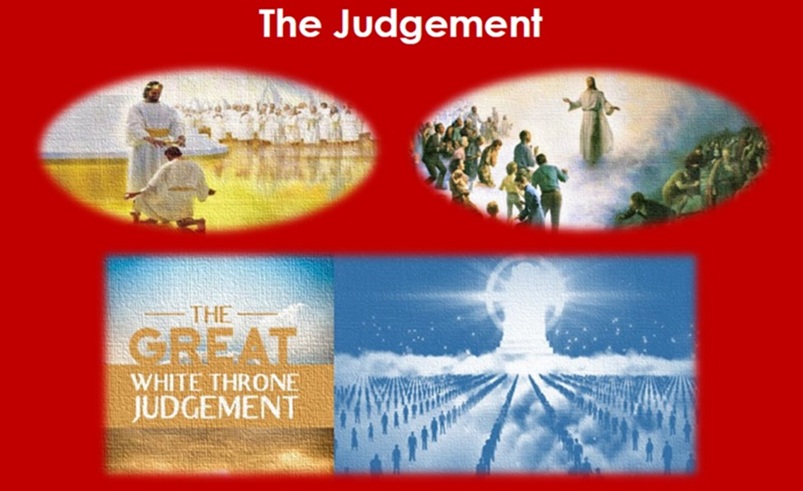
In Matthew, Yeshua speaks extensively about judgment. In the Parable of the Sheep and the Goats, He promises a final separation based on how people treated “the least of these” (Matthew 25:31–46). “And before Him shall be gathered all nations: and He shall separate them one from another, as a shepherd divideth His sheep from the goats:” (v. 32) This is not only about punishment but the establishment of justice. Those who lived with compassion inherit eternal life, while those who ignored suffering face exclusion.
Yeshua also warns of coming judgment for cities that rejected His message: “It shall be more tolerable for Tyre and Sidon at the day of judgment, than for you.” (Matthew 11:22)
Thus, accountability to revealed truth is a major aspect of Yeshua’s promise of justice.
While Mark is more concise, Yeshua reiterates the certainty of judgment: “Whosoever therefore shall be ashamed of Me and of My words in this adulterous and sinful generation; of him also shall the Son of Man be ashamed, when He cometh in the glory of His Father with the holy angels.” (Mark 8:38) Here, Yeshua links personal allegiance to His return in glory—promising justice for those who denied Him and reward for those who stood firm.
In Luke Yeshua’s parables highlight both judgment and divine fairness. In the Parable of the Rich Man and Lazarus (Luke 16:19–31), the reversal of fortunes after death is a clear image of justice—where the poor man is comforted, and the selfish rich man is judged. He also speaks of a day of reckoning: “But he that knew not, and did commit things worthy of stripes, shall be beaten with few stripes. For unto whomsoever much is given, of him shall be much required: and to whom men have committed much, of him they will ask the more.” (Luke 12:48) Justice is not arbitrary—it is based on what one has received and done.
John’s Gospel emphasizes that Yeshua Himself is the judge: “And hath given Him authority to execute judgment also, because He is the Son of man.” (John 5:27)
Judgment is tied to belief or unbelief in Yeshua (John 3:18). Yet, His purpose in coming was to save—not to condemn (John 3:17), showing that justice is tempered with mercy.
In Acts, the apostles boldly preach that Yeshua is the appointed judge: “Because he hath appointed a day, in the which he will judge the world in righteousness by that man whom he hath ordained; whereof he hath given assurance unto all men, in that he hath raised him from the dead.” (Acts 17:31)
Peter also declares: “And he commanded us to preach unto the people, and to testify that it is he which was ordained of God to be the Judge of quick and dead.” (Acts 10:42) The promise of judgment is not to terrify but to call all people to repentance.
In Revelation, judgment and justice culminate in the vision of the Final Judgment: “And I saw a great white throne, and him that sat on it, from whose face the earth and the heaven fled away; and there was found no place for them. And I saw the dead, small and great, stand before God; and the books were opened: and another book was opened, which is the book of life: and the dead were judged out of those things which were written in the books, according to their works. And the sea gave up the dead which were in it; and death and hell delivered up the dead which were in them: and they were judged every man according to their works. And death and hell were cast into the lake of fire. This is the second death. And whosoever was not found written in the book of life was cast into the lake of fire.” (Revelation 20:11–15) Those not found in the Book of Life face the second death, but God’s justice prevails over evil, and His people are vindicated (Revelation 6:10; 19:2).
Yeshua promises that judgment is real, righteous, and inescapable. Yet, it is also a promise of ultimate justice—evil will not go unpunished, and the faithful will be rewarded. His role as judge is tied to His mercy, giving all a chance to repent. His justice brings hope to the oppressed and accountability to the world, affirming that God’s kingdom is a place where righteousness dwells forever.
 If any man serve me, let him follow me [John 12:26]